Pakistan Leather Glove Exports: Top Buyer Countries 2025
Pakistan sold about USD 304 million of leather gloves abroad in 2025, up from USD 271 million in 2023. That makes Pakistan leather glove exports one of the steadiest parts of the country's leather trade. Most of these gloves are made in and around Sialkot, and most of them go to a short list of buyer countries. This guide shows exactly which countries buy them, which markets are growing fastest, and where big buyers still source very little from Pakistan.
We work with verified leather manufacturers in Pakistan, including glove makers in Sialkot, so we look at this data from the buyer's side: where the demand is, and what a glove brand or importer should check before placing an order.
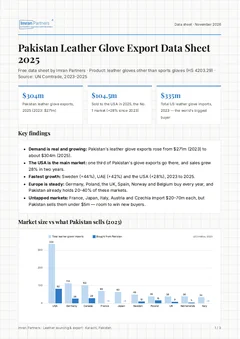
Free 3-page data sheet: the full country table, growth and opportunity markets, plus a buyer checklist for your first glove order.
⬇ Download free PDFQuick facts: Pakistan leather glove exports 2023–2025
- Total exports: USD 271.4m (2023), USD 308.1m (2024), USD 304.3m (2025).
- Largest buyer: the United States, with USD 104.5m in 2025, about one third of the total.
- Fastest growing markets: Sweden (+44%), the UAE (+42%) and the USA (+28%) between 2023 and 2025.
- Steady European demand: Germany, Poland, the UK, Spain, Norway, Belgium and the Netherlands buy every year.
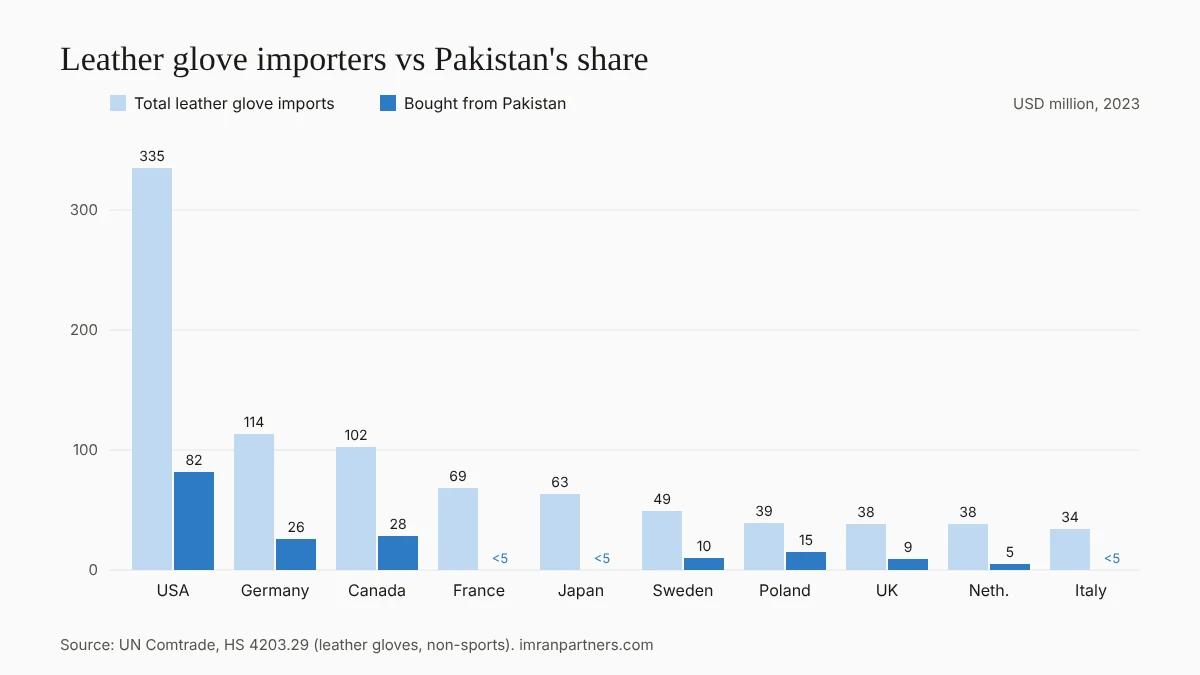
- Market share: Pakistan supplies roughly 20–40% of the leather gloves imported by its main markets, such as the USA (24%), Germany (23%), Canada (28%) and Poland (40%).
- Product code: all figures are for HS 4203.29, leather gloves other than sports gloves.
Which countries buy leather gloves from Pakistan?
The table below lists the top buyer countries for Pakistani leather gloves. "World imports" is how much that country imported from all suppliers in 2023, so you can see how big each market is and how much of it Pakistan already wins.
| Market | World imports 2023 (USD m) | From Pakistan 2023 | 2024 | 2025 | Pakistan share 2023 | Growth 2023–25 |
|---|---|---|---|---|---|---|
| USA | 335.2 | 81.8 | 98.5 | 104.5 | 24% | +28% |
| Germany | 113.6 | 26.1 | 27.7 | 27.7 | 23% | +6% |
| Canada | 102.3 | 28.3 | 32.2 | 27.5 | 28% | -3% |
| Poland | 38.9 | 15.4 | 16.3 | 14.7 | 40% | -5% |
| Sweden | 48.8 | 9.6 | 13.3 | 13.8 | 20% | +44% |
| UAE | – | 7.7 | 9.8 | 10.9 | – | +42% |
| United Kingdom | 38.2 | 9.0 | 10.1 | 9.7 | 24% | +8% |
| Saudi Arabia | – | 8.0 | 8.8 | 8.8 | – | +10% |
| Spain | 27.7 | 7.7 | 8.0 | 8.5 | 28% | +10% |
| Norway | 26.0 | 5.1 | 7.0 | 6.1 | 20% | +20% |
| Belgium | 19.9 | 6.0 | 6.5 | 6.0 | 30% | 0% |
| Netherlands | 38.1 | 4.9 | 5.2 | 5.4 | 13% | +10% |
| Australia | 23.3 | 5.2 | 6.0 | 5.3 | 22% | +2% |
Source: UN Comtrade, HS 4203.29, values in USD million, retrieved 19 November 2026. "–" means the country was not in the top 20 importers we pulled for 2023.
The USA: one third of all Pakistani leather glove exports
The United States is by far the biggest buyer of leather gloves in the world, at more than USD 335 million of imports in 2023. Pakistan supplied about a quarter of that, and its sales to the US grew from USD 81.8m to USD 104.5m in two years. Most of this is work and safety gloves for industry, construction, farming and welding, plus driving and winter gloves for retail.
Europe: Germany, Poland, the UK and the Nordics
Germany is the second largest market at about USD 27–28m a year. Poland is small in total size, but Pakistan supplies around 40% of everything it imports, which is the highest share of any major market. The UK, Spain, Belgium and the Netherlands each buy USD 5–10m a year. European buyers expect CE-marked work gloves, so certification matters more here than in many other markets.
Where is demand growing fastest?
If you compare 2023 with 2025, three markets stand out. Sweden grew 44%, the UAE grew 42% and the USA grew 28%. Norway also grew about 20%, even though 2025 was a little lower than 2024.
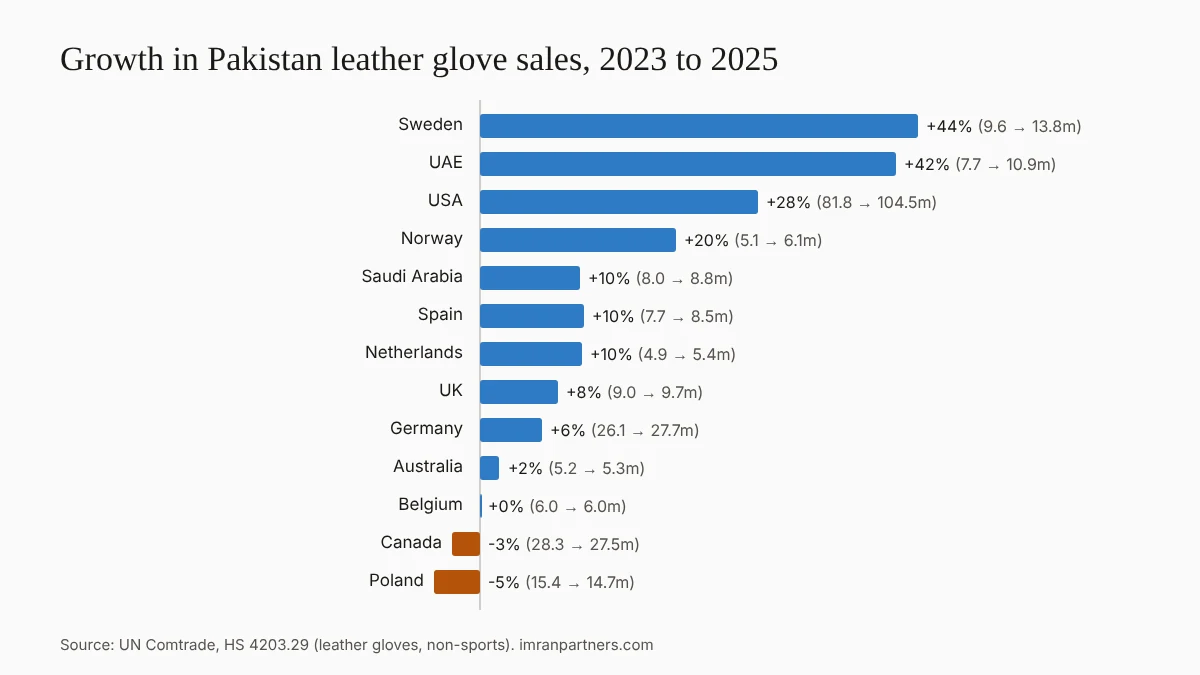
Two things explain most of this. The Nordic countries have long winters and a strong culture of outdoor work, so lined leather work gloves and winter gloves sell well. The UAE works as a trading hub: many gloves shipped to Dubai are sold on to the rest of the Gulf, Africa and Central Asia. Canada and Poland dipped slightly in 2025, which is normal year-to-year movement rather than a clear trend.
Big buyers where Pakistan is still small
The most interesting part of the data is not where Pakistan already sells, but where it does not. These countries import a lot of leather gloves, yet buy less than USD 5 million a year from Pakistan:
| Market | World imports 2023 (USD m) | Bought from Pakistan (USD m) |
|---|---|---|
| France | 68.7 | under 5 |
| Japan | 63.4 | under 5 |
| Italy | 33.8 | under 5 |
| Austria | 23.0 | under 5 |
| Mexico | 22.8 | under 5 |
| South Korea | 22.0 | under 5 |
| Czechia | 21.0 | under 5 |
For a glove brand or importer in these countries, this is useful to know: Pakistani glove makers are already proven in the USA and Germany at large volumes, so the same factories can usually meet French, Italian or Austrian specifications too. The gap is often simply that buyers have not looked at Pakistan yet. France reported some Pakistani glove imports again in 2025 (about USD 4.8m), which suggests the door is starting to open.
Why Sialkot leads Pakistan's glove industry
Almost all of Pakistan's leather gloves are made in Sialkot, in Punjab. The industry grew out of the city's sports goods trade (cricket and hockey equipment) and then moved into sports, winter, motorbike and industrial gloves. A Trade Development Authority of Pakistan gloves report counted about 550 member companies active in the glove sector.
The main types of leather gloves made for export are:
- Work gloves: cowhide and buffalo split leather, often with a cotton back, for construction, farming and warehouses.
- Welding gloves: thick split leather with long cuffs, heat resistant.
- Driver gloves: soft grain cowhide or goatskin, popular in the US for drivers and light industrial work.
- Winter and fashion gloves: sheepskin, lambskin and goatskin leather, often lined.
- Motorbike gloves: reinforced cowhide or goatskin with knuckle protection.
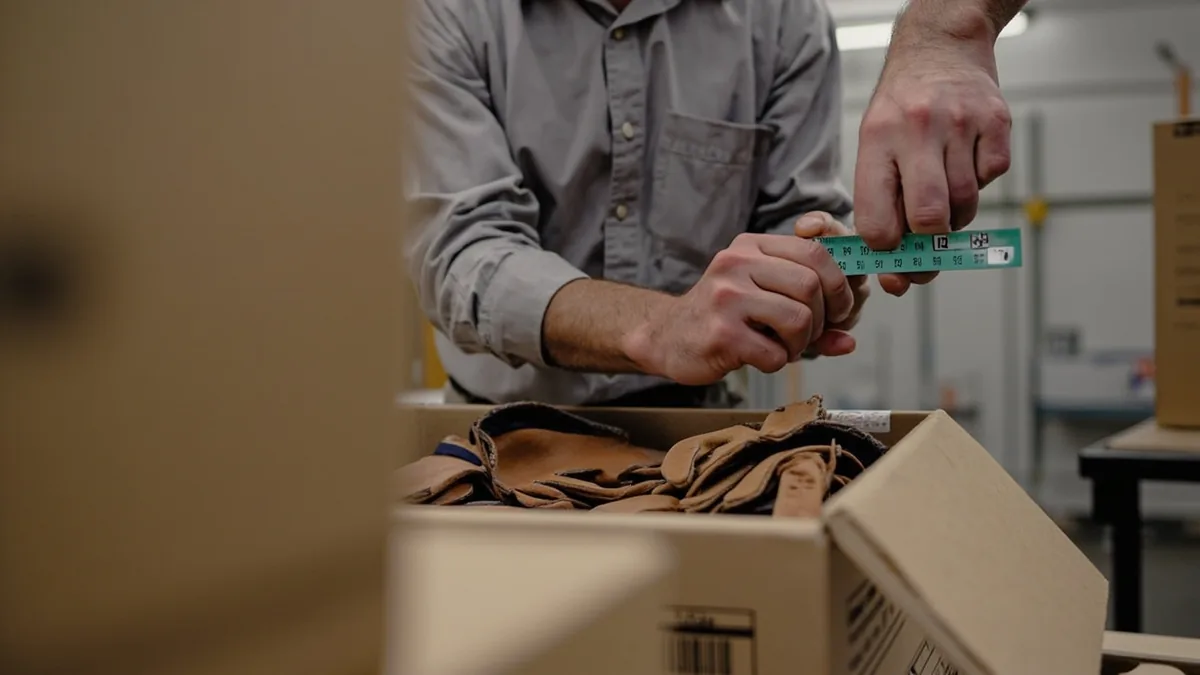
What buyers should check before ordering leather gloves from Pakistan
From the glove orders we help with, these are the points that decide whether a first order goes smoothly:
- Certification: for Europe, work gloves need CE marking, usually tested to EN 388 (mechanical risks) and EN 420 or ISO 21420 (general requirements). Ask for the test report, not just a CE logo on the sample.
- Leather type and grade: ask whether the palm is grain or split leather, and which animal (cow, buffalo, goat or sheep). Grain is softer and more dexterous; split is tougher and cheaper.
- MOQ: in our experience, Sialkot glove makers usually start from about 100 pairs per style for custom orders, though large work-glove factories often prefer full cartons per size.
- Lead time: plan on roughly 30–45 days for bulk after sample approval, longer in the peak season before winter.
- Sizing: confirm the size chart (S to XXL or 7 to 11) and ask for a size set before bulk. Our questions to ask a manufacturer before your first order cover the rest of the checks.
- Landed cost: work out duty and freight before you compare quotes. Our landed cost calculator and leather HS code finder help with this.
Where this data comes from
All export and import figures come from the UN Comtrade database, which collects official customs data reported by each country. We used product code HS 4203.29, defined in the World Customs Organization HS nomenclature as gloves, mittens and mitts of leather, other than sports gloves.
- Synthetic, knitted or coated gloves are not included. They are classed under other codes, such as HS 6116 (knitted gloves) and HS 3926.20 (plastic gloves).
- Sports gloves (HS 4203.21, for example cricket, baseball and goalkeeper gloves) are also a separate code.
- 2025 figures are recent and can still be revised by reporting countries. Values are in US dollars and rounded.
Pakistan's own statistics show the same picture: leather gloves are the second largest leather export after garments, as Leather International reported from Pakistan Bureau of Statistics data.
Frequently asked questions
How much are Pakistan's leather glove exports worth?
About USD 304 million in 2025, according to UN Comtrade data for HS 4203.29. Exports were USD 271 million in 2023 and USD 308 million in 2024.
Which country buys the most leather gloves from Pakistan?
The United States. It bought about USD 104.5 million of Pakistani leather gloves in 2025, roughly one third of all Pakistan leather glove exports.
Where are leather gloves made in Pakistan?
Mainly in Sialkot, Punjab. The city's glove industry grew from its sports goods trade and now makes work, welding, driving, winter and motorbike gloves.
What is the HS code for leather gloves?
HS 4203.29 covers leather gloves other than sports gloves. Sports gloves are HS 4203.21. Check the exact code for your product with your customs broker.
Which markets are growing fastest for Pakistani leather gloves?
Between 2023 and 2025, Sweden grew 44%, the UAE 42% and the USA 28%. Norway also grew about 20%.
Do Pakistani work gloves meet European standards?
Many Sialkot factories supply CE-marked gloves tested to EN 388 and EN 420 or ISO 21420 for European buyers. Always ask for the test report from an accredited lab before ordering.
Source leather gloves from Pakistan
Pakistan leather glove exports keep growing because Sialkot factories offer solid quality, real leather and fair prices at volume. If you are a glove brand, distributor or importer and want samples or quotes from verified Sialkot glove makers, send us your glove brief. We match you with the right factory, check samples and quality, and manage the order through to shipment.
Cover image and photos in this guide are AI-generated illustrations. Data: UN Comtrade, retrieved 19 November 2026.

Muhammad Imran is the founder of Imran Partners, a leather sourcing partner based in Karachi, Pakistan. He works with leather goods manufacturers across Pakistan to help brands source jackets, bags, wallets, belts and gloves, from leather selection and sampling to quality checks before shipment.
Muhammad Imran on LinkedIn