Goatskin Leather: What It Is, Pros, Cons and Best Uses
Goatskin leather is leather made from the hide of a goat. It is light, strong and soft, with a fine pebbled grain you can often spot at a glance. It sits between two better-known leathers: it is lighter and more supple than cowhide, and tougher than lambskin. That balance is why brands use it for gloves, jackets, bags and wallets, and why it has been used for book covers and flight jackets for centuries.
This guide explains what goatskin is, how it compares with cowhide and lambskin, the main types and finishes, what thickness to ask for, and how to spec it when you order products from a manufacturer.
What is goatskin leather?
Goatskin is the tanned skin of a domestic goat. Most of it is a by-product of the meat trade: goats are raised for meat and milk, and the skins go to tanneries rather than being thrown away. Skins from young goats are called kidskin or kid leather, which is thinner and even softer.
Goats are raised in large numbers across Asia and Africa. China, India, Pakistan and Bangladesh have the largest goat populations in Asia, and together with Nigeria they are among the top goat-keeping countries in the world (Livestock Research for Rural Development). That is why so much goatskin is tanned and made into products in South Asia.
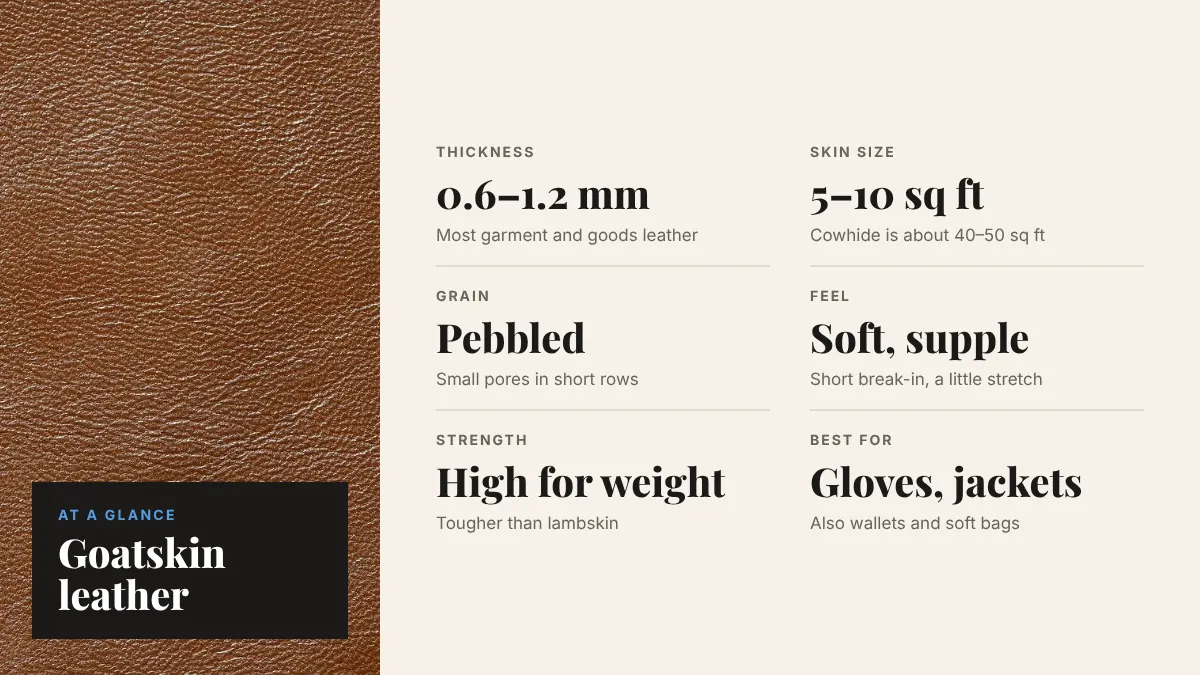
Because goats are smaller than cattle, a goatskin is small too. A typical skin gives roughly 5 to 10 square feet of usable leather, compared with around 40 to 50 square feet for a full cowhide. That matters for cutting: a large panel, like the back of a long coat, may need to be joined from two skins.
Goatskin leather at a glance
| Property | Typical goatskin |
|---|---|
| Source | Domestic goats, mostly a by-product of the meat trade |
| Grain | Fine, pebbled grain with small pores in short rows |
| Thickness | About 0.6 to 1.2 mm for most garment and goods leather |
| Skin size | Roughly 5 to 10 sq ft per skin |
| Feel | Soft and supple, with a little stretch |
| Strength | High tear and abrasion resistance for its weight |
| Common tannages | Chrome tanned (most garments and gloves), vegetable tanned (bookbinding, some bags) |
| Main uses | Gloves, jackets, bags, wallets, shoe uppers, book covers |
Characteristics of goatskin
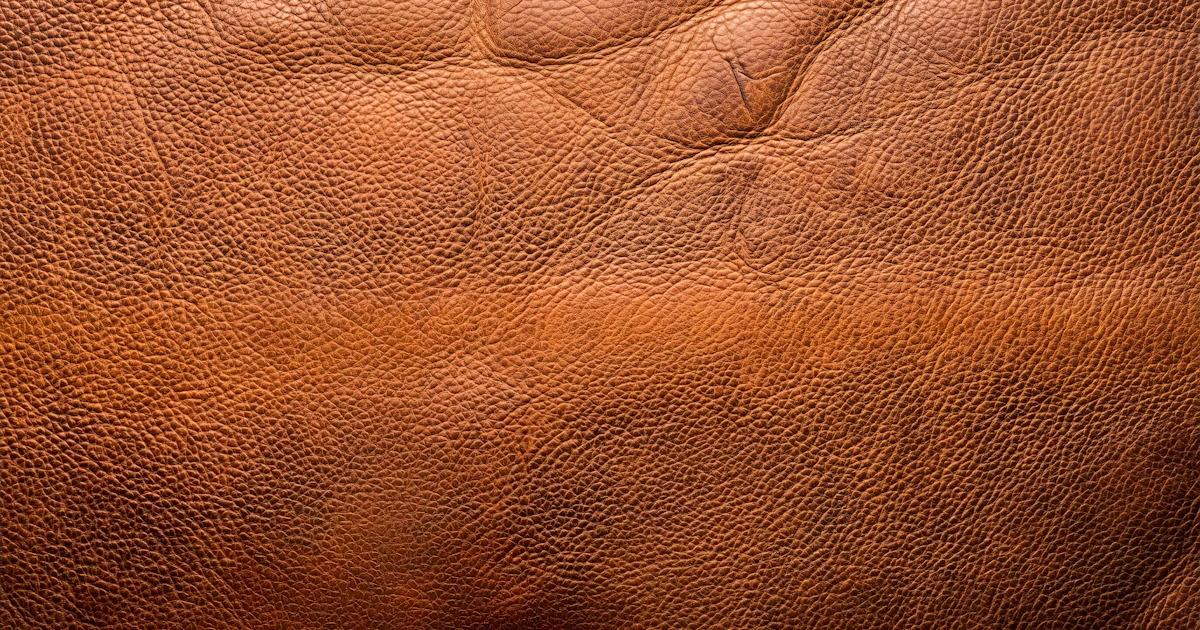
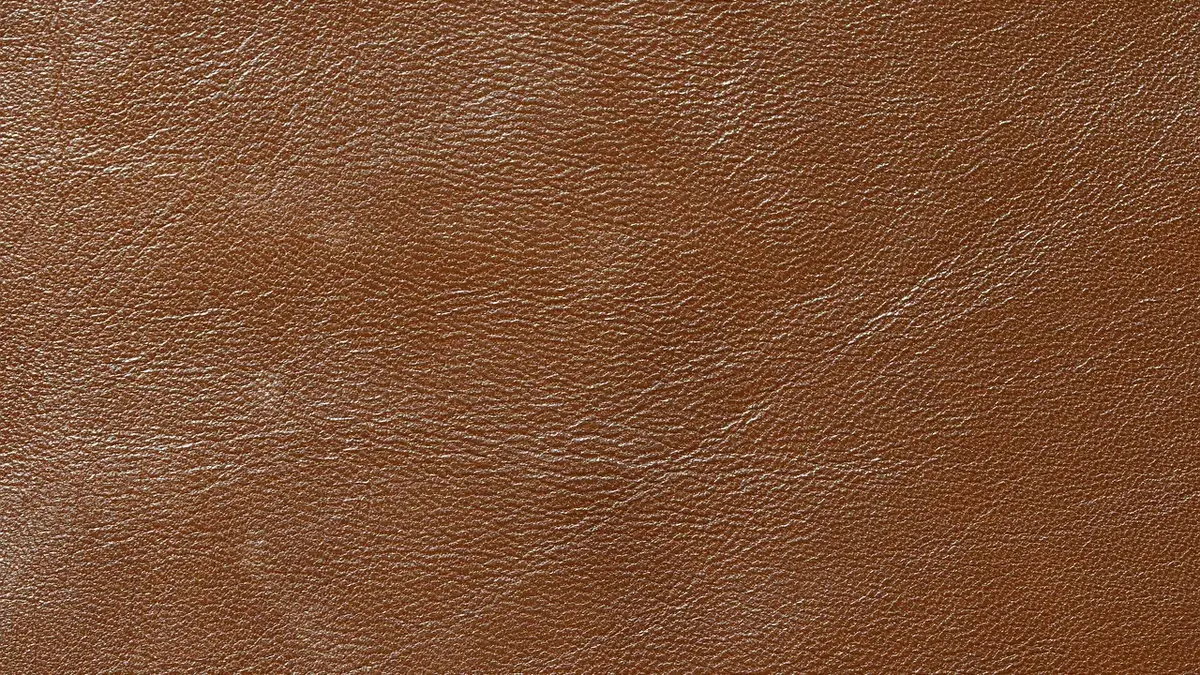
Grain. The surface has a natural pebble-like texture. Under a loupe, you will usually see small pores grouped in short, slightly curved rows. Many tanneries keep this grain visible because it is part of the appeal.
Strength for its weight. Goatskin has a dense, tightly packed fibre structure. A thin goatskin can resist tearing and scuffing better than a lambskin of the same thickness, which is why it is popular for work and driving gloves.
Softness. It breaks in quickly and does not feel stiff, even when new. It is not as buttery as lambskin, but it is far more flexible than most cowhide.
Light weight. A goatskin jacket is usually noticeably lighter than a cowhide jacket of the same style, which makes it more comfortable in warm or mild climates.
Patina. Full grain and aniline goatskin darken and soften with use, much like other quality leathers.
Pros and cons of goatskin leather
| Pros | Cons |
|---|---|
| Light and comfortable to wear | Small skins mean more joins on large panels |
| Strong and tear resistant for its thickness | Less structure than cowhide, so bags need good lining and reinforcement |
| Soft from day one, short break-in | Grain varies between skins, so colour and texture matching takes care |
| Attractive natural grain and patina | Not as smooth or luxurious to the touch as lambskin |
| Works for both garments and small leather goods | Not waterproof unless treated |
Goatskin vs cowhide vs lambskin
These are the three leathers most buyers choose between for jackets and small leather goods. Here is how they usually compare. Each depends on grade and finish, so treat this as a general guide, not a rule.
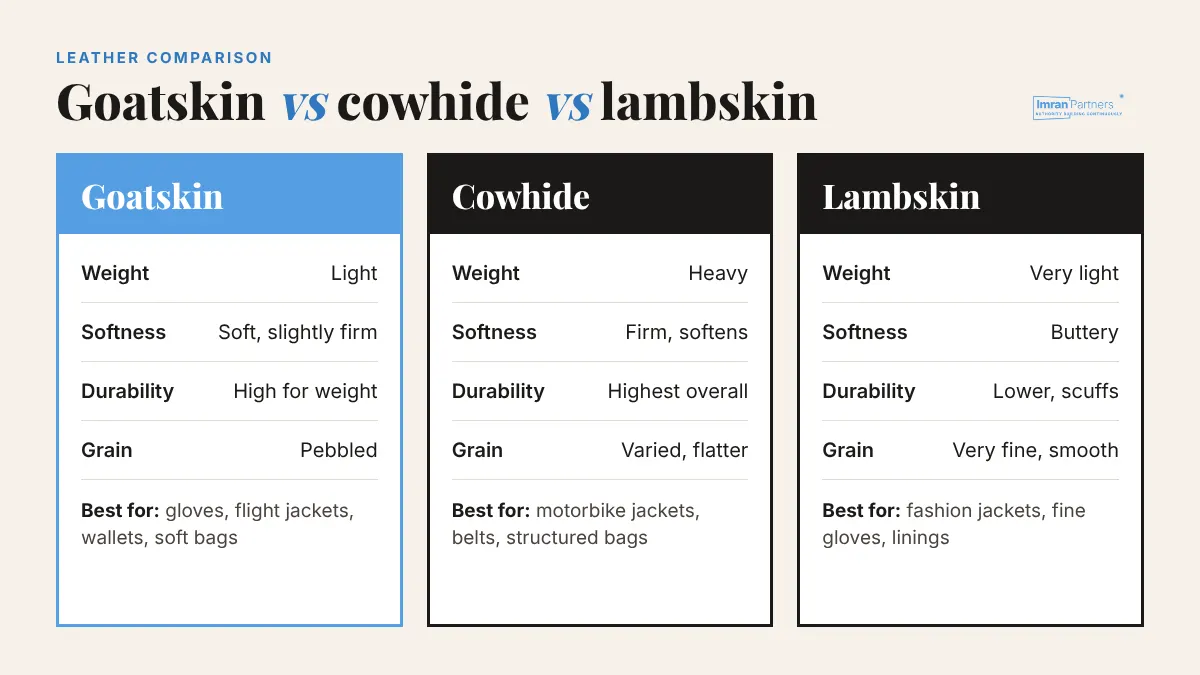
| Goatskin | Cowhide | Lambskin | |
|---|---|---|---|
| Weight | Light | Heavy | Very light |
| Softness | Soft, slightly firm | Firm, softens over time | Very soft, buttery |
| Durability | High for its weight | Highest overall | Lower, scuffs easily |
| Grain | Pebbled, visible | Varied, often smoother | Very fine, smooth |
| Hide size | Small (about 5 to 10 sq ft) | Large (about 40 to 50 sq ft) | Small (about 5 to 8 sq ft) |
| Best for | Gloves, jackets, wallets, light bags | Motorbike jackets, belts, structured bags | Fashion jackets, fine gloves, linings |
A simple way to choose: pick cowhide when protection and structure matter most, lambskin when softness and a luxury feel matter most, and goatskin when you want a balance of both in a lighter product.
Types of goatskin leather
Goatskin comes in the same grades and finishes as other leathers. The type you choose changes the look, feel and price far more than the animal does.
- Full grain goatskin. The whole grain layer is kept, so the natural pebble texture and any small marks remain. It is the most durable and ages best.
- Corrected or top grain goatskin. The surface is lightly sanded and given a finish coat to hide marks. It looks more even but breathes less.
- Goat suede. Made from the flesh side or a split, buffed to a soft nap. Common in gloves, linings and fashion pieces.
- Goat nubuck. The grain side is buffed to a fine velvety surface. Read our guide to what nubuck leather is to see how it differs from suede.
- Kidskin. Leather from young goats. Thinner, lighter and smoother, used for fine gloves and dress shoes.
- Vegetable tanned goatskin (Morocco leather). Tanned with plant tannins, often with a strong grain. Traditionally used for bookbinding and fine bags.
- Chrome tanned goatskin. Tanned with chromium salts, which makes it softer, more colour-stable and a little more water resistant. Most goatskin jackets and gloves are chrome tanned.
What is goatskin leather used for?
Gloves. This is goatskin's best-known use. It stays flexible, gives good grip and stands up to friction, so it is used for work, driving, riding and fashion gloves.
Jackets. Goatskin is a classic for flight and casual jackets. The US Navy's G-1 flight jacket was originally specified in 1940 in chocolate brown, chrome tanned goatskin, and it was later worn by Navy, Marine Corps and Coast Guard aircrews (Wikipedia). Today it is a popular middle ground for brands that want a lighter jacket than cowhide without the fragility of lambskin.
Bags and wallets. Goatskin makes soft, slouchy bags, pouches, wallets and card holders. Its pebbled grain hides small scratches well.
Shoes. Kidskin is used for shoe uppers and linings where a soft, close fit is needed.
Bookbinding. Fine bookbinders have used vegetable tanned goatskin for centuries. The St Cuthbert Gospel in the British Library, which has the oldest surviving European binding, is covered in red goatskin (Wikipedia).
Drums and crafts. Untanned or lightly treated goatskin is also used for drum heads, such as the djembe.
Choosing goatskin for your product
If you are a brand ordering goatskin products, the most useful thing you can do is put clear specs in your tech pack. "Goat leather, brown" is not enough. Two factories can read that very differently.
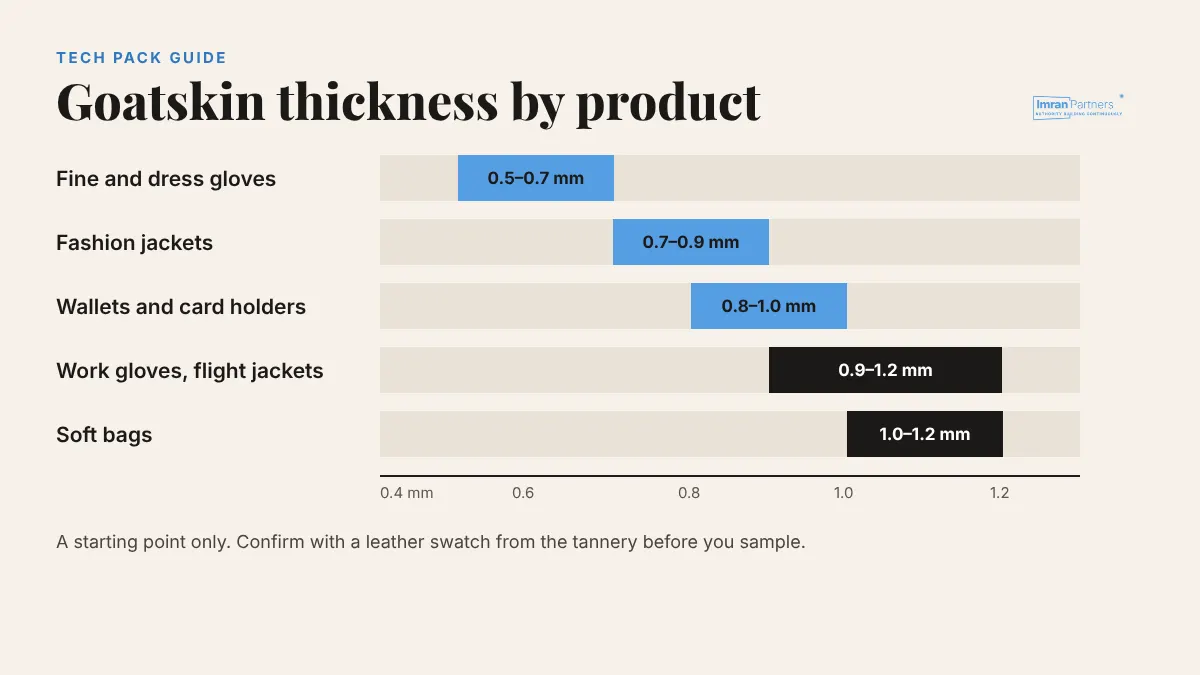
As a starting point, these thickness ranges work for most products:
- Fine and dress gloves: about 0.5 to 0.7 mm
- Fashion jackets: about 0.7 to 0.9 mm
- Work gloves and flight-style jackets: about 0.9 to 1.2 mm
- Wallets and card holders: about 0.8 to 1.0 mm, often with a lining
- Soft bags: about 1.0 to 1.2 mm, with reinforcement at handles and stress points
Then write these in your spec:
- Hide: goatskin (or kidskin)
- Grade: full grain, top grain or corrected
- Tannage: chrome, vegetable or combination
- Finish: aniline, semi-aniline, pigmented, suede or nubuck
- Thickness range in mm, for example 0.8 to 1.0 mm
- Colour reference, ideally a physical swatch or Pantone
- Any certification you need, such as a tannery with an LWG rating
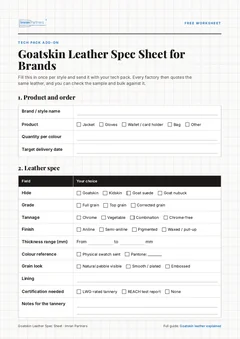
Free 2-page worksheet: fill in hide, grade, tannage, finish and thickness once per style, then check the swatch and sample against it.
⬇ Download free PDFAsk for a leather swatch from the same tannery before you approve a sample, and keep a sealed counter sample for bulk. Because skins are small, also ask the factory to check colour and grain matching across panels during cutting.
Where goatskin comes from and sourcing it from Pakistan
Large goat populations mean a steady supply of skins in South Asia. Pakistan has tanneries that process goat and sheep skins alongside cowhide, and workshops that turn them into garments, gloves and small leather goods.
Different cities have different strengths. Sialkot is known for gloves and motorbike gear, Lahore for fashion jackets, and Karachi for large tanneries and export factories making bags and wallets. Our guide on how to find a leather goods manufacturer in Pakistan explains how to shortlist and vet factories, and our page on leather jacket manufacturers in Pakistan covers jackets in more detail.
When you compare quotes, make sure every factory is pricing the same leather spec. A low price on "goat leather" may mean a corrected grain or a thinner skin than the one you sampled.
How to tell goatskin from cowhide or lambskin
- Look at the grain. Goatskin shows a pebbled surface with small pores in short rows. Cowhide pores are usually more scattered and the surface flatter. Lambskin is very smooth with tiny, barely visible pores.
- Feel the weight. Hold two similar pieces. Goatskin feels lighter than cowhide of the same size.
- Bend it. Goatskin folds easily and springs back. Lambskin feels almost like fabric. Cowhide resists more.
- Check the edge. A cut edge of real leather shows a fibrous layer, not fabric backing. Our guide on how to tell if leather is real covers the full set of tests.
Heavily finished or embossed leather can hide the grain, so when in doubt, ask the supplier for the tannery's leather spec in writing.
How to care for goatskin leather
- Wipe off dust and dirt with a soft, dry cloth.
- If it gets wet, blot it and let it dry at room temperature, away from heaters and direct sun.
- Condition smooth goatskin every few months with a leather conditioner. Test on a hidden spot first.
- Use a suede brush and protector spray on goat suede and nubuck instead of conditioner.
- Store jackets on wide hangers and bags stuffed with paper, in a breathable cotton bag.
Frequently asked questions
Is goatskin a good leather?
Yes. Goatskin is a durable, light and soft leather. It is a good choice for gloves, jackets, wallets and soft bags, especially when you want a balance between toughness and comfort.
Is goatskin more durable than cowhide?
Cowhide is usually more durable overall because it is thicker. For its weight, goatskin is very strong and tear resistant, and it is more durable than lambskin.
Is goatskin leather waterproof?
No. Like other leathers it can absorb water. Chrome tanning and a finish or protector spray make it water resistant, but it should be dried slowly if it gets soaked.
Does goatskin leather stretch?
A little. Goatskin gives slightly with wear, so gloves and fitted jackets mould to the body. It stretches less than lambskin.
Is goatskin leather expensive?
It is often priced above cowhide per square foot and below fine lambskin, but the grade, finish and tannery affect the price more than the animal. Full grain aniline goatskin costs more than corrected grain.
Does goatskin leather smell?
Good goatskin has a normal leather smell. A strong, sour or chemical smell usually points to poor finishing or drying, not the hide itself.
What is goat leather called?
It is called goatskin or goat leather. Leather from young goats is called kidskin or kid leather, and traditional vegetable tanned goatskin is often called Morocco leather.
Is goatskin or cowhide better for a jacket?
Choose cowhide for a heavy, protective motorbike jacket. Choose goatskin for a lighter flight, bomber or everyday jacket that is comfortable from the first day.
Conclusion
Goatskin leather gives you strength without the weight of cowhide and softness without the fragility of lambskin. It suits gloves, jackets, wallets and soft bags, and it ages well. To get the result you expect, put the grade, tannage, finish and thickness in your tech pack, and check a swatch before you sample.
Planning a goatskin product? Send us your design and quantities and we will match you with verified manufacturers in Pakistan that work with the leather you need. We are a sourcing partner, not a factory, so we can compare options for you and run QC before shipping.

Muhammad Imran is the founder of Imran Partners, a leather sourcing partner based in Karachi, Pakistan. He works with leather goods manufacturers across Pakistan to help brands source jackets, bags, wallets, belts and gloves, from leather selection and sampling to quality checks before shipment.