
Nubuck vs. Velour vs. Chamois: Understanding Soft Leathers
M
Muhammad Imran
•I hope you enjoy this post. My team and I can help showcase your expertise like this. Let's talk.
A technical comparison between the three most popular soft leather finishes, examining their grain structure, tanning methods, and practical applications in high-end craftsmanship.
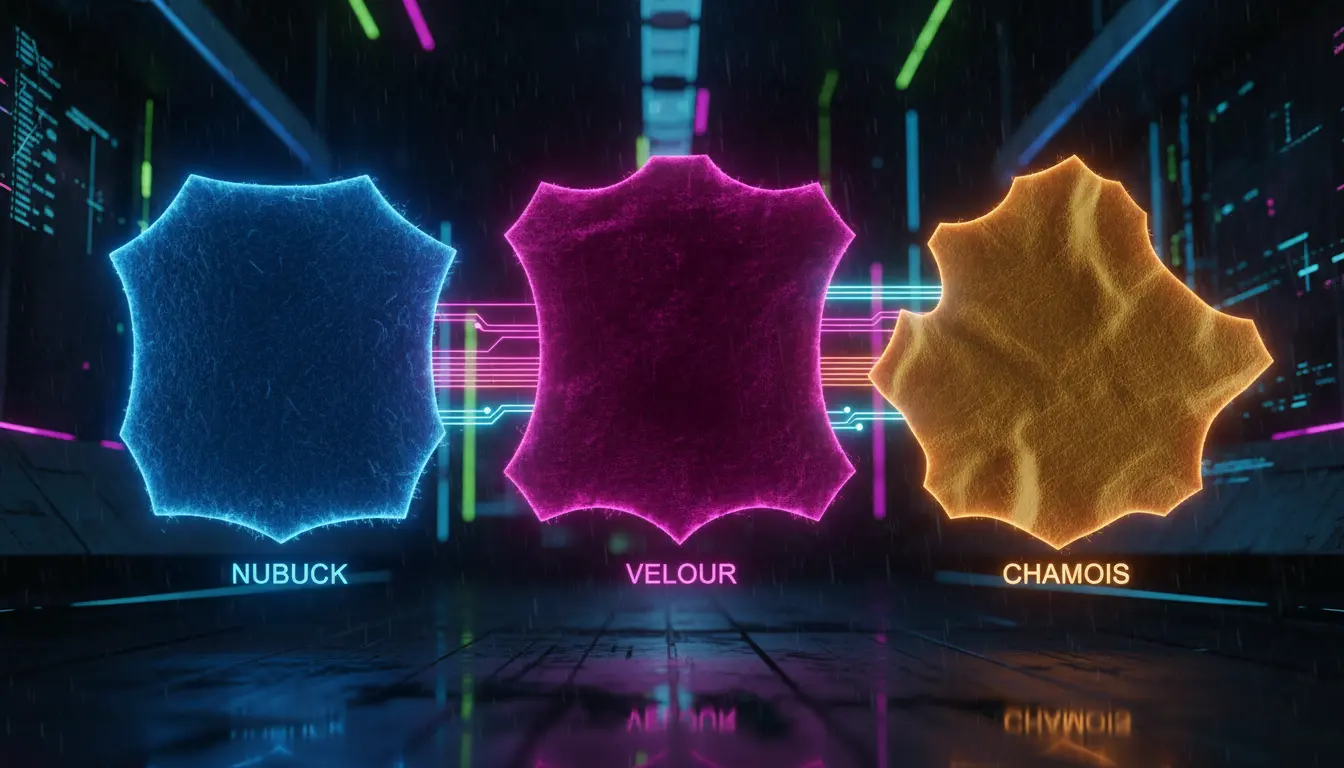
Understanding Soft Leathers <p>Walk into a high-end tannery or a bespoke cordwainer’s workshop, and the air hangs heavy with the scent of tannins, oils, and the unmistakable earthiness of cured hide. To the uninitiated, the taxonomy of 'soft leathers' is a blur of fuzzy textures. You run your hand across a surface - it’s napped, it’s matte, it yields to pressure.</p><p>But is it the sanded grain of a steer? The oil-cured split of a sheep? or the velvet-finished flesh of a calf?</p> <p>Distinguishing between Nubuck, Velour, and Chamois isn't semantic pedantry; it is a matter of structural integrity, chemical processing, and functional application. As a craftsman, I can tell you that treating a chrome-tanned velour like an oil-tanned chamois will result in a ruined garment. Treating nubuck like a cheap split suede is a financial tragedy.</p><p>This guide cuts through the marketing fluff. We are going down into the corium, examining the fiber density, the tanning liquors, and the mechanical finishing that separates these three distinct materials. For a comprehensive foundation before we dissect the differences, I strongly suggest you consult <a href="/posts/the-ultimate-master-guide-to-nubuck-leather-characteristics-care-and-comparisons">the ultimate master guide to nubuck leather: characteristics, care, and comparisons</a>, as Nubuck serves as the high-performance benchmark in this trio.</p> Defining the Soft Leather Family <p>To understand these materials, you must first visualize the cross-section of a raw hide. A hide is not a uniform slab; it is a complex strata of protein fibers. At the top, you have the grain layer - tightly packed, vertical fibers designed by nature to protect the animal from elements and abrasion. Below that lies the corium, or the reticular layer, where fibers become looser, more horizontal, and less dense.</p> <p>The 'softness' or 'nap' in leather is achieved by mechanically disrupting these fibers. However, where that disruption occurs and how the hide was tanned determines everything.</p><ul><li>Nubuck works on the grain side (the outside).</li><li>Velour (in the strict leather context) works on the flesh side or the flesh split.</li><li>Chamois is a flesh split that undergoes a radical oil tanning process.</li></ul><p>If you are struggling to distinguish high-end finishes from cheaper alternatives, understanding the base architecture is key. You can read more about the nuances of grain manipulation in our analysis of <a href="/posts/nubuck-vs-suede-the-definitive-comparison-guide">nubuck vs. suede: the definitive comparison guide</a>, which lays the groundwork for understanding fiber exposure.</p> Velour: Characteristics and Uses <h3>The Anatomy of Velour</h3><p>Velour leather refers to a specific type of finished split or flesh-side leather. It is often used interchangeably with 'suede,' but in high-end craftsmanship, Velour implies a finer, silkier finish than the rough, 'hairy' nap of standard suede. Velour is created from the flesh split of the hide - usually cattle hide or calfskin. Because the fibers here are not as tightly interlinked as the grain, the resulting nap is longer and softer. It has a distinct 'writing effect' - when you brush your hand across it, the fibers change direction, altering the shade of the color significantly.</p> <h3>The Tanning Nuance</h3><p>Velour is almost exclusively chrome-tanned. Chrome salts yield a leather that is soft, pliable, and holds dye with exceptional vibrancy. This makes Velour a favorite for garment leather - jackets, skirts, and gloves where drape is more important than abrasion resistance. It does not possess the structural rigidity of grain leather. However, because it lacks the grain layer, Velour is porous. It absorbs water instantly and stains easily. It is strictly a luxury aesthetic material, not a utility one.</p> Chamois: The Oil-Tanned Sponge <h3>The Chemistry of Oil Tanning</h3><p>Chamois (pronounced 'shammy') undergoes oil tanning, one of the oldest preservation methods known to man. After the grain is split off, the remaining flesh split is impregnated with marine oils - traditionally cod oil. The skins are pummeled in 'kicking machines' to drive the oil deep into the fiber network. The skins are then allowed to heat up naturally; this is an oxidation process. The oil oxidizes inside the hide, chemically bonding with the collagen fibers and turning into aldehydes. This is a chemical transformation.</p> <h3>The Hydrophilic Paradox</h3><p>Most leathers are hydrophobic (water-repelling) to some degree. Chamois is hydrophilic. The oxidation process prevents the collagen fibers from gluing together when they dry. This creates a permanent, open-sponge structure. This is why Chamois is the ultimate cleaning cloth. It can absorb many times its weight in water, wring out dry, and remain soft. A true Chamois has no surface finish - no pigments, no polymers. It has zero abrasion resistance and virtually no tensile strength, but its absorbency is unrivaled.</p> Nubuck: The Strongest of the Trio <h3>Grain Structure Integrity</h3><p>If Chamois is the sponge and Velour is the drape, Nubuck is the shield. Nubuck is top-grain cattle hide that has been sanded or buffed on the grain side (the outer surface). Because the sanding action is performed on the grain, the fibers involved are microscopic and tightly packed. This results in a nap that is incredibly short - often described as 'peach fuzz.' Nubuck retains the tensile strength and durability of full-grain leather. It is thick, robust, and resistant to tearing.</p> <h3>The Confusion with Synthetics</h3><p>The manufacturing journey of this material is intense. To understand how a tough hide becomes a velvet-soft boot, read our breakdown of <a href="/posts/the-tanning-process-how-nubuck-is-made-from-top-grain">the tanning process: how nubuck is made from top-grain</a>. Because nubuck is a premium material, the market is flooded with fakes. 'Faux Nubuck' is often just microfiber or a synthetic coagulate. Real nubuck has imperfections; it breathes. To ensure you aren't buying plastic, check our guide on <a href="/posts/real-nubuck-vs-synthetic-faux-nubuck-how-to-spot-the-fake">real nubuck vs. synthetic (faux) nubuck: how to spot the fake</a>.</p> Visual and Tactile Differences <h3>1. Nap Length and Texture</h3><p>Velour: The nap is visible to the naked eye. It feels soft, but slightly 'dry' or 'cottony.'<br>Nubuck: The nap is so short it looks matte rather than hairy. The texture is extremely fine, often feeling like velvet. It feels dense and substantial.<br>Chamois: The texture is almost soapy or felt-like. It is very open and soft.</p> <h3>2. Weight and Drape</h3><p>Velour: Tends to be lighter and drapes like a heavy fabric. It folds easily.<br>Nubuck: Heavier and stiffer. It will hold a shape.<br>Chamois: Zero rigidity. It behaves like a wet rag even when dry.</p><h3>3. Surface Finish</h3><p>Velour: Often dyed in bright, vibrant colors.<br>Nubuck: Rich, deep coloration.<br>Chamois: Usually natural yellow or cream.</p> Maintenance Comparisons <h3>Cleaning Chamois & Velour</h3><p>Chamois is unique because you can wash it with mild soap and water. The oil tannage prevents it from hardening effectively. Velour is delicate. Water is the enemy. It mats the long fibers down, creating ugly flat spots. Maintenance involves a soft bristle brush to fluff the fibers. Stains are difficult to remove because the porous split absorbs liquids deep into the corium.</p> <h3>Caring for Nubuck</h3><p>Nubuck requires a disciplined regimen. You generally use a crepe brush or a rubber 'eraser' block to lift dirt from the short nap. Unlike Velour, you can - and should - waterproof Nubuck. For footwear specific instructions: <a href="/posts/how-to-clean-nubuck-leather-shoes-a-step-by-step-guide">how to clean nubuck leather shoes: a step-by-step guide</a>. For dealing with the inevitable water encounter: <a href="/posts/nubuck-in-rain-and-snow-survival-guide">nubuck in rain and snow: survival guide</a>.</p> Which Should You Choose? <p>The choice between Nubuck, Velour, and Chamois is dictated entirely by the application.</p><ul><li>Choose Nubuck if: You need durability alongside luxury. This is the material for hiking boots, premium footwear, and high-end upholstery.</li><li>Choose Velour if: You are designing fashion garments where drape and softness are paramount. Think evening gloves or interior linings of luxury bags.</li><li>Choose Chamois if: You need utility. You are washing a car or need a soft lining for an orthopedic brace.</li></ul> <p>In the workshop, I respect all three. The Chamois cleans my tools; the Velour lines the boxes I make; the Nubuck forms the boots I wear while working. Understanding the tanning process, the layer of the hide (flesh vs. grain), and the chemical finish allows you to appreciate the specific engineering behind every square inch of these soft leathers.</p><p>Don't be the person who ruins a $400 pair of boots because they treated them like a $10 wash cloth. Respect the material, and it will last a lifetime.</p>