EN 388 Glove Ratings Explained: Codes and Cut Levels
The small shield on a work glove with a code like 4X43FP under it is the EN 388 rating. It tells you how well the glove stood up to abrasion, cuts, tearing, puncture and, in some cases, impact in a lab test. In the USA you will also see ANSI cut levels such as A3 or A5. This guide explains how to read both, what level fits which job, and, from the importer's side, how to check that a rating on a supplier's quote is real before you order thousands of pairs.
We source work gloves from verified manufacturers in Pakistan, and buyers often ask us what a rating means and whether a factory's claim can be trusted. So this is written for brands, distributors and safety-supply buyers, not only for end users.
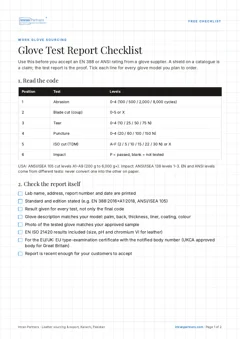
Free 2-page checklist: how to read a glove test report from a supplier, the red flags, and the questions to send before you order.
⬇ Download free PDFWhat is EN 388?
EN 388 is the European standard for protective gloves against mechanical risks. The current edition is EN 388:2016 (with an amendment in 2018). It sets lab tests for five risks: abrasion, blade cut, tear, puncture and, as an option, impact. A glove that passes is marked with a shield pictogram and a row of four to six numbers and letters.
EN 388 is used far beyond Europe. Buyers in the UK, Canada, Australia, the Gulf and South America ask for it, and many gloves sold in the USA carry the European shield next to their ANSI marks. One thing to know early: EN 388 only covers mechanical risks. Heat, chemicals and cold have their own standards, and every glove must also meet the general rules in EN ISO 21420 (more on that below).
How to read the EN 388 code
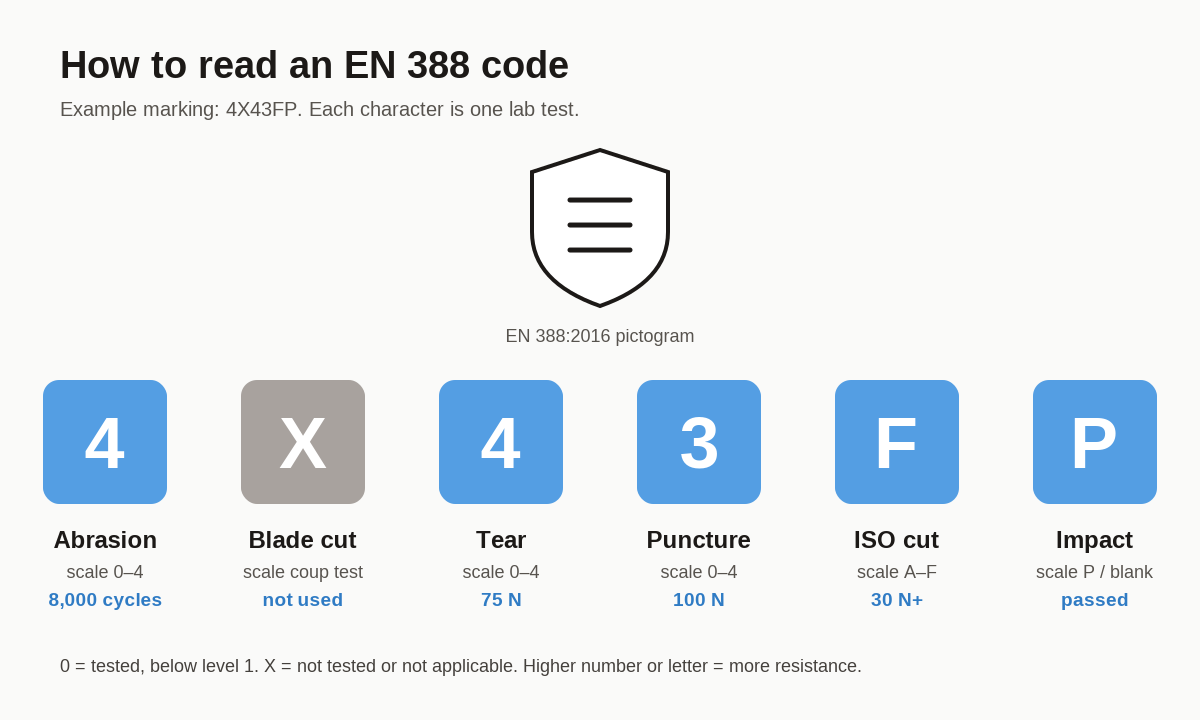
Each position in the code is one test. Read it from left to right.
| Position | Test | Scale | What it measures |
|---|---|---|---|
| 1 | Abrasion | 0 to 4 | Cycles of sandpaper rubbing before a hole: 100, 500, 2,000, 8,000 |
| 2 | Blade cut (coup test) | 0 to 5 or X | A rotating blade; index of 1.2, 2.5, 5.0, 10.0, 20.0 |
| 3 | Tear | 0 to 4 | Force to tear the material: 10, 25, 50, 75 newtons |
| 4 | Puncture | 0 to 4 | Force for a point to go through: 20, 60, 100, 150 newtons |
| 5 | ISO cut (TDM test) | A to F or X | Force for a straight blade to cut through: 2, 5, 10, 15, 22, 30 newtons |
| 6 | Impact | P or blank | P means the knuckle area passed the impact test |
A 0 means the glove was tested and did not reach level 1. An X means the test was not done or does not apply. For cut, the X is common: strong cut-resistant fibres can dull the coup test blade, so the result would be wrong. In that case the lab runs the ISO 13997 (TDM) test instead and the coup position shows X.
Example: what does 4X43FP mean?
- 4 = top abrasion level (8,000 cycles)
- X = coup cut test not used
- 4 = top tear level (75 N)
- 3 = puncture level 3 (100 N)
- F = top ISO cut level (30 N or more)
- P = passed the impact test
Example: what does 2121X mean?
People search this code a lot because it shows up on cheap general-purpose gloves. It means abrasion 2, coup cut 1, tear 2, puncture 1, and no ISO cut test. In plain words: light handling protection, low cut resistance. That is fine for picking, packing and light assembly, not for sheet metal or glass.
ANSI cut levels A1 to A9
In the USA the main glove standard is ANSI/ISEA 105. Since the 2016 edition, cut resistance is shown as A1 to A9, based on the weight in grams a blade needs to cut through the material in an ASTM F2992 test on a TDM machine.
| ANSI level | Grams to cut | Typical work |
|---|---|---|
| A1 | 200 to 499 g | Light handling, small parts |
| A2 | 500 to 999 g | General assembly, warehouse |
| A3 | 1,000 to 1,499 g | Construction, light metal handling |
| A4 | 1,500 to 2,199 g | Sheet metal, HVAC, glass handling |
| A5 | 2,200 to 2,999 g | Metal stamping, heavy glass |
| A6 | 3,000 to 3,999 g | High cut risk, sharp metal parts |
| A7 to A9 | 4,000 to 6,000+ g | Very sharp edges, blades, recycling lines |
ANSI/ISEA 105 also rates abrasion (0 to 6) and puncture (0 to 5), but most buyers focus on the cut level because it drives price.
EN 388 vs ANSI: are the levels the same?
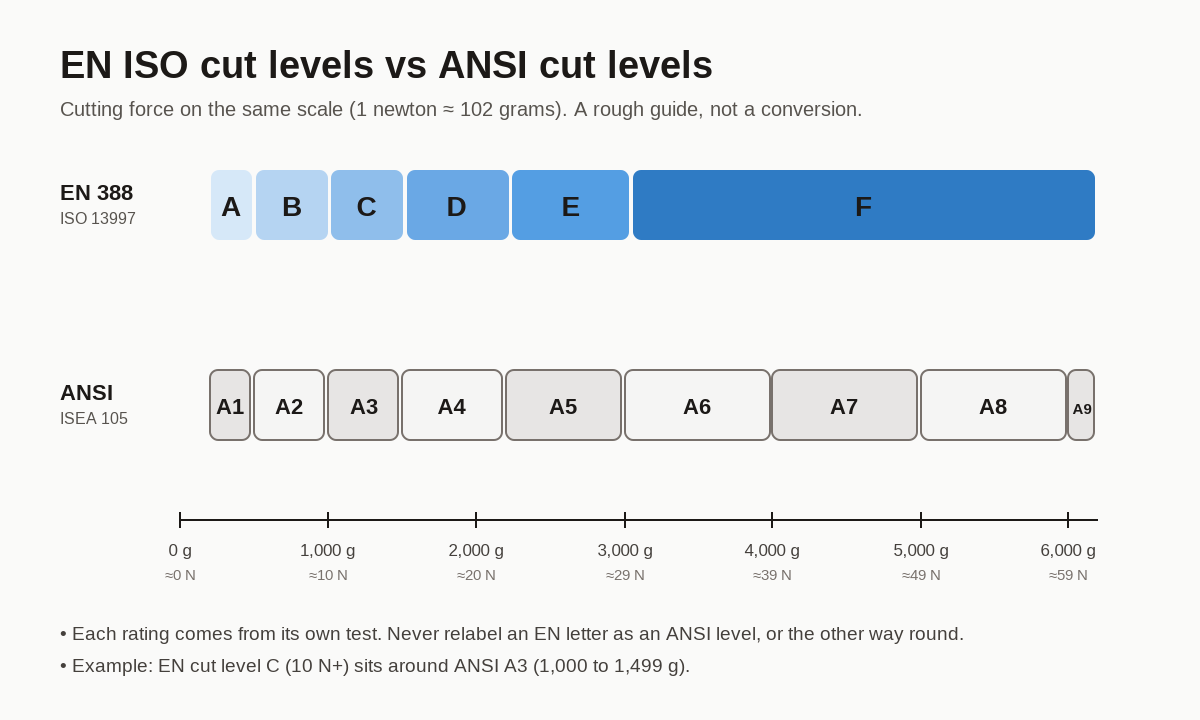
They are close but not equal. The EN ISO cut test (A to F) and the ANSI test (A1 to A9) both use a TDM machine and a straight blade, but they report results in different units and the bands do not line up one to one. So a glove that is EN cut level C is usually around ANSI A3, but you cannot swap one number for the other on a label or a spec sheet.
Two practical rules for buyers:
- If you sell in the USA, ask for an ANSI/ISEA 105 report. If you sell in the EU or UK, ask for EN 388:2016. Many buyers ask for both.
- Never let a supplier "convert" a rating on paper. Each rating must come from its own test.
Impact ratings: EN 388 "P" and ANSI/ISEA 138
Impact gloves with TPR guards on the back of the hand can be tested for impact. Under the European standard the result is a single pass or fail: a P at the end of the code means the knuckle area passed. In the USA, impact has its own standard, ANSI/ISEA 138, with three levels (1 to 3). Level 3 lets the least force through to the hand.
This matters for impact gloves and oilfield impact gloves. A glove can look tough with thick rubber guards and still not have a tested rating. On our own glove pages we say clearly when no rating is claimed, and we check testing with the manufacturer when a buyer needs it.
Which level do you need for which job?
| Job | What to look for |
|---|---|
| Warehouse, picking, packing | Abrasion 2+, ANSI A1 to A2 or EN cut A to B |
| General construction, driving, rigging | Abrasion 3+, tear 3+, ANSI A2 to A3 |
| Sheet metal, HVAC, glass | ANSI A4 to A5 or EN cut C to D |
| Metal stamping, sharp parts, recycling | ANSI A6+ or EN cut E to F |
| Oil and gas, heavy equipment | Abrasion 3+, impact P or ANSI/ISEA 138 level 2+ |
| Welding | EN 388 plus EN 12477 (welding) and EN 407 (heat) |
Higher is not always better. A higher cut level usually means a thicker glove, less feel and a higher price. Pick the lowest level that covers the real risk. Your customer's safety team or a risk assessment should set the final level.
Welding gloves need heat protection as well as a mechanical rating. Our guide to the best welding gloves for TIG, MIG and stick covers leather, features and the EN 12477 types.
Where do leather work gloves usually fit?
Plain leather work gloves and mechanic gloves are strong on abrasion and tear, because leather is tough to rub through and hard to rip. Cut resistance depends on the leather's thickness and on any liner. Leather alone usually tests low to medium for cut; gloves that need high cut levels add a liner made of HPPE, aramid or steel fibre. The only way to know a specific glove's level is to test that exact glove: same leather, same thickness, same liner.
EN ISO 21420: the rule every glove must pass
Before any mechanical-risk marking counts, a glove must meet EN ISO 21420, the general requirements for protective gloves. It covers sizing, dexterity, labelling and the safety of the materials. For leather this is important: the leather must stay within a set pH range and must not contain chromium VI above the test limit. Chrome-tanned leather that was tanned or stored badly can fail this test, so ask for it in the report too.
How to check a supplier's glove rating before you order
This is where most problems happen. A catalogue can print any shield and any code. Here is what we ask for, and what we suggest you check, before a bulk order.
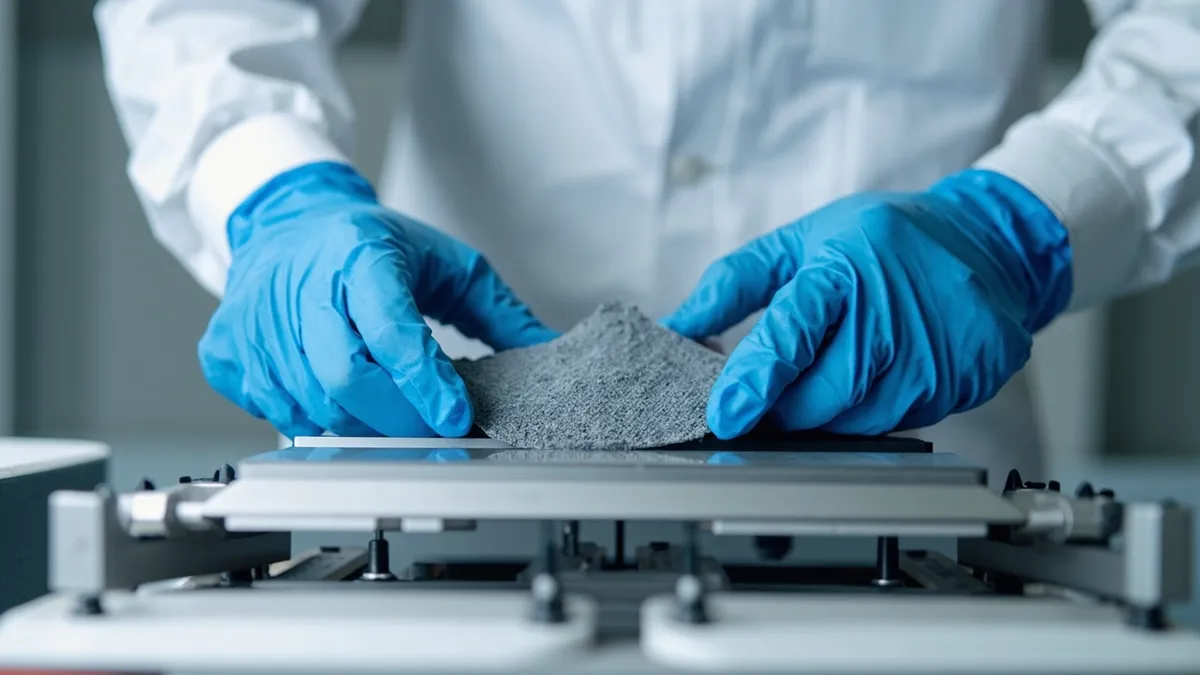
- Ask for the full test report, not a badge. A real report names the lab, the report number and date, the standard and edition (for example EN 388:2016+A1:2018), and the result of every test.
- Match the glove. The report must describe the same model: palm material, thickness, liner, coating and colour. A report for a different glove from the same factory does not count.
- Check the lab. Reports from known labs such as SGS, Intertek, Bureau Veritas, TÜV or SATRA are easy to check. You can email the lab with the report number and ask them to confirm it.
- For the EU and UK, check the certificate. Gloves for mechanical risks are Category II PPE, so they need an EU type-examination certificate from a notified body (UKCA approved body for Great Britain). The notified body's four-digit number should appear on the paperwork.
- Look at the date. An old report on an old edition of the standard may not be accepted by your customers.
- Test your own production if the order is large. Ask for a few pairs from the bulk run to be sent to a lab. It costs far less than a recall.
Red flags: a shield on the catalogue but no report; a report with no lab name or number; a code that changes between the catalogue and the quote; ratings that look too good for the price; or "we can print any rating you need". If you see any of these, stop and ask for proof.
What we see in our own sourcing
In our own sourcing, most glove catalogues we receive from Pakistani manufacturers show the product, the materials and the export markets, but not a test report. That is why our glove pages say clearly that no rating is claimed. When a buyer needs EN 388 or ANSI levels, we ask the manufacturer for the report on that exact model before we quote, and if there is none, we plan testing on the approved sample.
Our advice: decide early whether you need a rated glove. Testing adds time and cost, so it is better to plan it before the sample stage than to ask for it after the bulk order is placed.
If you are sourcing from Pakistan, we can ask the manufacturer for existing reports and, where there is none, help arrange testing on approved samples before production. See our questions to ask a manufacturer for the other checks that go with a first order, and our Pakistan leather glove exports guide for where the country's gloves are sold.
Frequently asked questions
What does EN 388 mean on gloves?
It means the glove was tested to the European standard for mechanical risks. The numbers and letters under the shield show its levels for abrasion, blade cut, tear, puncture, ISO cut and, if marked with P, impact.
What is the highest EN 388 rating?
The highest possible code is 4544FP: abrasion 4, coup cut 5, tear 4, puncture 4, ISO cut F and impact passed. In practice most high-cut gloves show X in the coup position, such as 4X44FP.
What does X mean in an EN 388 rating?
X means the test was not done or does not apply to that glove. For cut, an X in the second position usually means the ISO cut test (the letter) was used instead of the coup test.
Is EN 388 cut level 5 the same as ANSI A5?
No. The old EN coup level 5 and ANSI A5 come from different tests. Compare the EN ISO letter (A to F) with the ANSI level only as a rough guide, and ask for the test that your market needs.
What cut level do I need for sheet metal?
Most sheet metal work needs ANSI A4 to A5 or EN cut level C to D. Very sharp or heavy parts may need more. A risk assessment should set the final level.
Do leather gloves have a cut rating?
Only if that exact glove was tested. Leather gives good abrasion and tear results, but cut levels are usually low to medium unless the glove has a cut-resistant liner.
Can a Pakistani glove manufacturer supply EN 388 certified gloves?
Many Sialkot glove makers export certified gloves to Europe and the USA. Always ask for the report for the exact model you are buying, and check it with the lab before you order.
Conclusion
A glove rating is useful only when you can read it and trust it. Read the code position by position, match the cut level to the real risk, and treat any rating as unproven until you have the report for that exact glove. If you need work gloves with tested ratings, or want to source gloves first and test them for your market, see our wholesale work gloves from Pakistan, try the landed cost calculator, or send us your glove brief.
Cover image and photos in this guide are AI-generated illustrations. Ratings and levels summarised from the 2016+A1:2018 edition of the European standard, EN ISO 21420 and ANSI/ISEA 105 / 138. Check the current standard text before writing a specification.

Muhammad Imran is the founder of Imran Partners, a leather sourcing partner based in Karachi, Pakistan. He works with leather goods manufacturers across Pakistan to help brands source jackets, bags, wallets, belts and gloves, from leather selection and sampling to quality checks before shipment.
Muhammad Imran on LinkedIn