Free tool

Leather thickness chart & converter: oz to mm, inches & irons

Type a thickness in any unit, see it to scale and find out what it is good for. Or pick what you are making to get the usual thickness range. Full leather weight charts are below the tool.

Convert from
0.3 mm3.5 mm7 mm
4ounces
1.59millimetres
0.063″inches (4/64)
3.0irons
Get leather goods made
What are you making?
Pick an item to see the thickness it is usually made in.

Typical ranges used by leather goods factories. Softer leathers (lambskin, goat) sit at the low end, cowhide and buffalo at the high end. Hides vary by about ±0.2 mm.

Reference

Leather thickness chart by use

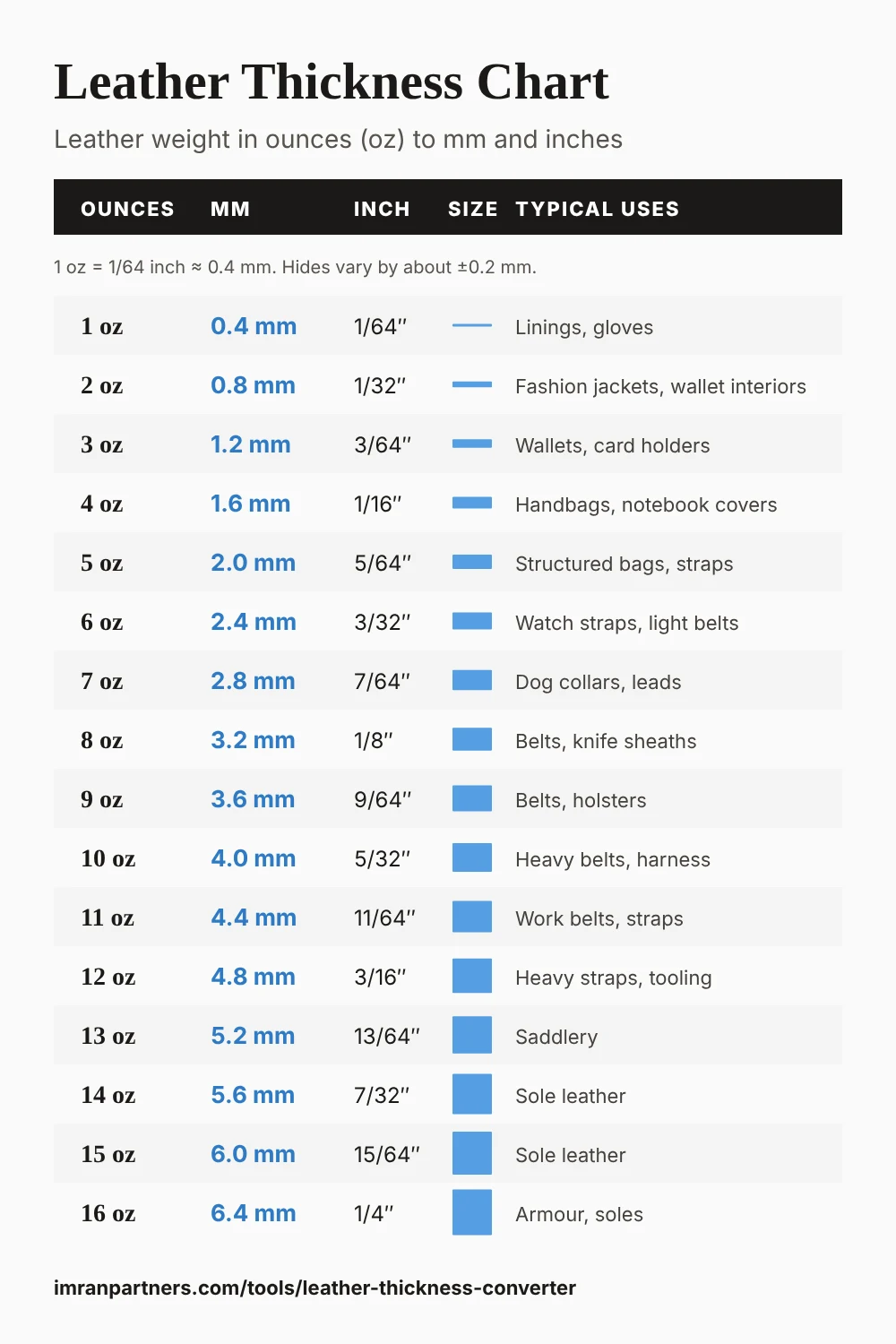
1 oz = 1/64 inch ≈ 0.4 mm. Click a row to load it into the converter.

OuncesMillimetresInchesTypical uses
1–2 oz0.4–0.8 mm1/64–2/64″Linings, gloves, lambskin garments, bookbinding
2–3 oz0.8–1.2 mm2/64–3/64″Fashion jackets, wallet interiors, light pouches
3–4 oz1.2–1.6 mm3/64–4/64″Wallets, card holders, motorcycle jackets, shoe uppers
4–5 oz1.6–2.0 mm4/64–5/64″Handbags, totes, notebook covers, small bags
5–6 oz2.0–2.4 mm5/64–6/64″Structured bags, bag straps, cases
6–7 oz2.4–2.8 mm6/64–7/64″Watch straps, light belts, dog collars
7–8 oz2.8–3.2 mm7/64–8/64″Dog collars, leads, light holsters
8–10 oz3.2–4.0 mm1/8–5/32″Belts, knife sheaths, holsters
10–12 oz4.0–4.8 mm5/32–3/16″Heavy belts, harness, work straps
12–16 oz4.8–6.4 mm3/16–1/4″Sole leather, tooling, armour
Every weight

Leather weight chart: oz to mm and inches

Exact values for each weight. Click a row to load it into the converter.

OuncesMillimetresInchesInch decimal
0.5 oz0.20 mm1/128″0.0078″
1 oz0.40 mm1/64″0.0156″
1.5 oz0.60 mm3/128″0.0234″
2 oz0.79 mm1/32″0.0312″
2.5 oz0.99 mm5/128″0.0391″
3 oz1.19 mm3/64″0.0469″
3.5 oz1.39 mm7/128″0.0547″
4 oz1.59 mm1/16″0.0625″
4.5 oz1.79 mm9/128″0.0703″
5 oz1.98 mm5/64″0.0781″
5.5 oz2.18 mm11/128″0.0859″
6 oz2.38 mm3/32″0.0938″
6.5 oz2.58 mm13/128″0.1016″
7 oz2.78 mm7/64″0.1094″
7.5 oz2.98 mm15/128″0.1172″
8 oz3.17 mm1/8″0.1250″
9 oz3.57 mm9/64″0.1406″
10 oz3.97 mm5/32″0.1562″
11 oz4.37 mm11/64″0.1719″
12 oz4.76 mm3/16″0.1875″
13 oz5.16 mm13/64″0.2031″
14 oz5.56 mm7/32″0.2188″
15 oz5.95 mm15/64″0.2344″
16 oz6.35 mm1/4″0.2500″

Tanneries and suppliers usually round 1 oz to 0.4 mm, so 4 oz is sold as 1.6 mm and 8 oz as 3.2 mm. The exact figure is 0.397 mm per ounce.

Leather thickness chart: 1 to 16 oz leather in mm and inches with typical uses for each weight
Save or pin this leather thickness chart.

Leather weight vs thickness

In leatherwork, "weight" and "thickness" mean the same thing. When a tannery sells 4–5 oz leather it is telling you the thickness, not what the hide weighs. The ounce comes from an old rule: one square foot of vegetable-tanned leather, 1/64 inch thick, weighed about one ounce. So 1 oz = 1/64 inch ≈ 0.4 mm, and every extra ounce adds another 1/64 inch.

Garment and chrome-tanned leather (jackets, gloves, bags) is often quoted straight in millimetres, for example 0.9–1.1 mm. Tooling and veg-tan leather is usually quoted in ounces. Sole leather is sometimes quoted in irons (1 iron = 1/48 inch ≈ 0.53 mm).

Leather weight categories

CategoryOuncesMillimetresUsed for
Lightweight1–3 oz0.4–1.2 mmGarments, gloves, linings, wallet interiors
Medium weight4–7 oz1.6–2.8 mmWallet exteriors, bags, straps, notebook covers
Heavyweight8–11 oz3.2–4.4 mmBelts, holsters, knife sheaths, dog collars
Extra heavyweight12 oz +4.8 mm +Saddlery, harness, sole leather, armour

How to measure leather thickness

  1. Use a dial thickness gauge or digital calipers. A dial gauge with a flat foot is best because it does not squeeze soft leather. Calipers work too, but close them gently.
  2. Measure in several places. Check at least 4–5 points away from the edges. The belly is thinner and softer than the back (the bend), so one reading is not enough.
  3. Read in mm, then convert. Divide mm by 0.4 to get ounces (2.0 mm ÷ 0.4 = 5 oz), or type it into the converter above.
  4. Allow for a range. Hides vary by about ±0.2 mm even after splitting, which is why leather is sold as 3–4 oz or 1.2–1.4 mm instead of one number.

For production orders, put the thickness and tolerance in your tech pack (for example "1.0–1.2 mm, ±0.1 mm") and check it on the approved sample. When we source leather goods for brands, thickness is one of the first things checked on every sample, because a supplier can quietly switch to a thinner split to cut cost. See our supplier checklist for the other checks.

What leather thickness should I use?

Not sure your leather is genuine at all? Start with how to tell if leather is real.

Leather thickness FAQ

How many mm is 1 oz of leather?

1 oz leather is 1/64 inch thick, which is about 0.4 mm (0.397 mm). So 4 oz is about 1.6 mm and 8 oz is about 3.2 mm.

Why is leather measured in ounces?

Traditionally one square foot of vegetable-tanned leather 1/64 inch thick weighed about one ounce, so tanners used ounces as a thickness unit. Today oz is simply a thickness measure: 1 oz = 1/64 inch.

Why is leather sold as a range like 3–4 oz?

Splitting machines and natural hides are never perfectly even, so tanneries quote a range. Expect about ±0.2 mm across a hide, so always confirm thickness on the sample before bulk production.

What thickness is a leather jacket?

Fashion jackets usually use 0.8–1.2 mm (2–3 oz) lambskin, goatskin or cowhide. Motorcycle jackets use thicker cowhide or buffalo, typically 1.2–1.4 mm (3–3.5 oz).

What thickness is a leather belt?

Most belts are 3.2–4.4 mm (8–11 oz). Dress belts are often thinner leather folded or lined; work belts use a single heavy layer.

What is an iron?

Irons are used mainly for sole leather: 1 iron = 1/48 inch ≈ 0.53 mm, so 1 iron = 1⅓ oz.

How thick is 3.5 oz leather?

3.5 oz leather is 3.5/64 inch, about 1.39 mm (0.055″). It is a common weight for wallets, card holders and motorcycle jacket cowhide.

How thick is 4 oz leather?

4 oz leather is 1/16 inch, about 1.59 mm (usually sold as 1.6 mm). It suits wallet exteriors, notebook covers and small bags.

How thick is 6 oz leather?

6 oz leather is 3/32 inch, about 2.38 mm (usually sold as 2.4 mm). It is used for structured bags, watch straps and light belts.

How thick is 8 oz leather?

8 oz leather is 1/8 inch, about 3.18 mm (usually sold as 3.2 mm). It is a standard weight for belts, knife sheaths and holsters.

Is leather weight the same as thickness?

In leatherwork, yes: the ounce figure is a thickness, not the weight of the hide. 1 oz means 1/64 inch. Two hides of the same ounce weight can still weigh differently because of size, tannage and finish.

Does thicker leather mean stronger leather?

Not always. Thicker leather resists stretching and tearing better, but strength also depends on the cut (full grain is stronger than a split of the same thickness), the part of the hide and the tannage.

What leather thickness is best for beginners?

Many beginners start with 4–5 oz (1.6–2.0 mm) vegetable-tanned leather. It is easy to cut, stitch and tool, and works for card holders, keyfobs and small cases.

Need leather goods made to an exact thickness?

We source jackets, bags, wallets and belts from verified Pakistani manufacturers and check the thickness on every sample.
Get a quoteMore free tools