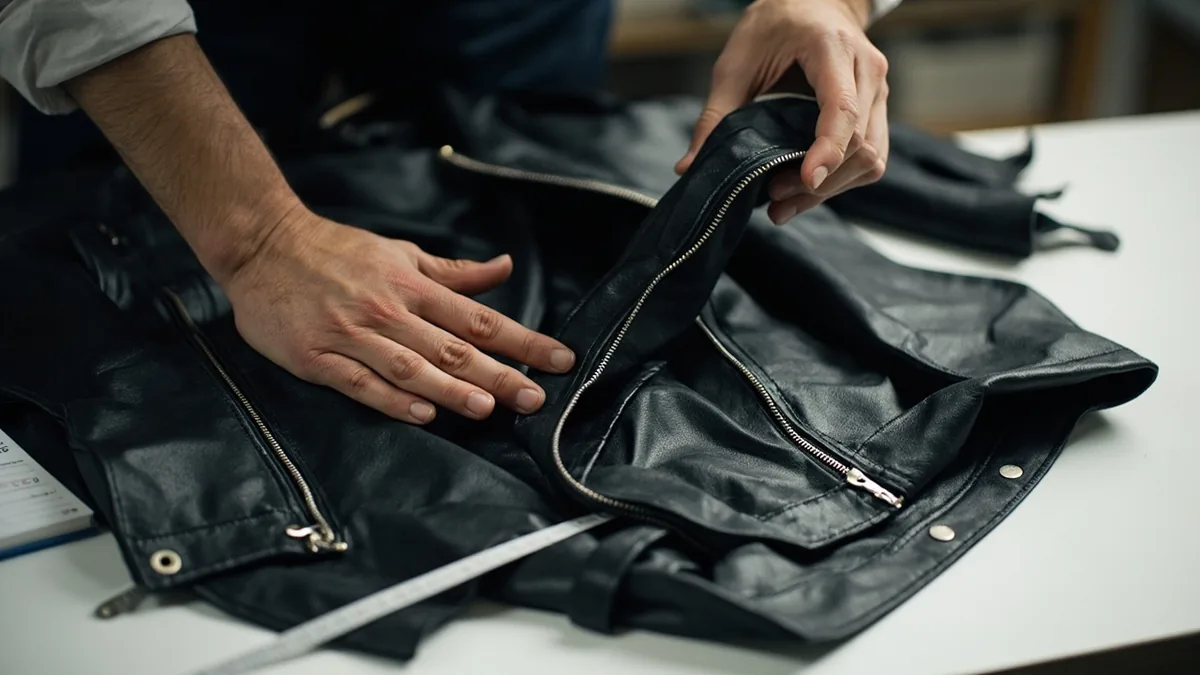
What Is a Sourcing Agent? When a Leather Brand Needs One
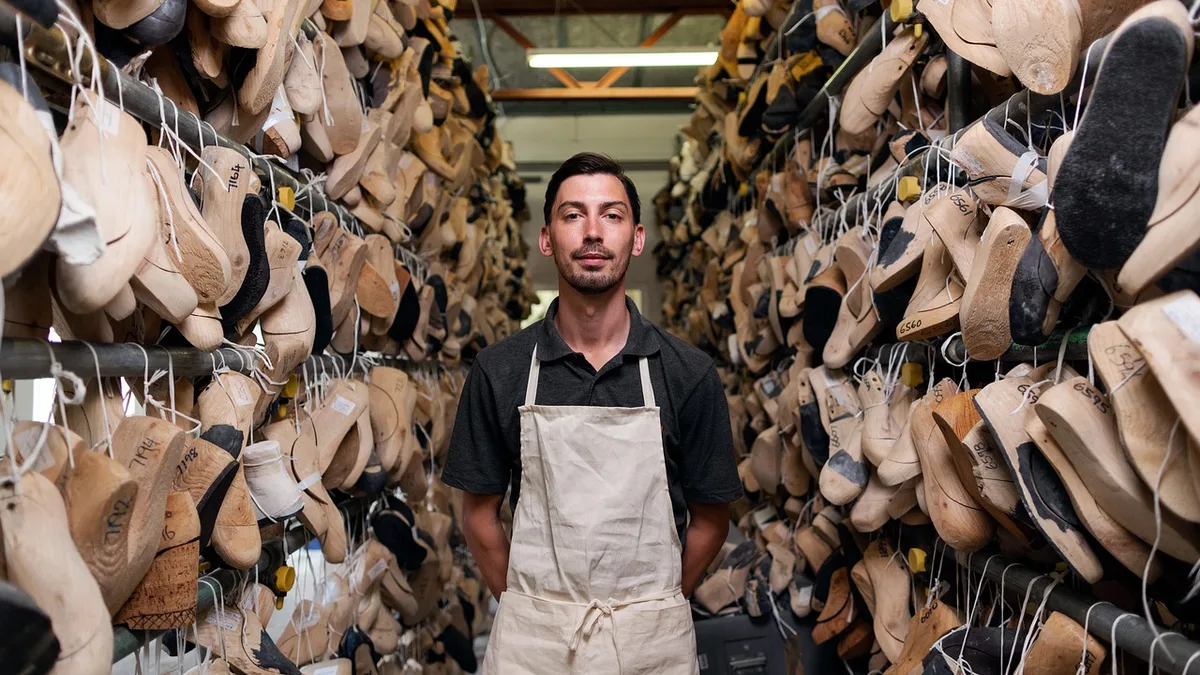
A sourcing agent is a person or company in the supplier's country who finds manufacturers for you, negotiates prices, checks samples and quality, and helps get the goods shipped. They work for the buyer, not the factory. If you are a brand buying leather jackets, bags or wallets from overseas, they act as your eyes and ears on the factory floor.
We work on the buyer's side in Karachi, sourcing leather goods from verified Pakistani manufacturers for brands abroad. This guide explains what a sourcing agent does, the different types, how they charge, when a leather brand really needs one (and when it does not), and how to choose one without getting burned.
What is a sourcing agent?
A sourcing agent is an independent middle person between a buyer and the factories that make the product. The agent's job is to help the buyer buy well: the right supplier, the right price, the right quality, on time. A good agent does not make the goods, does not own the workshop and does not hide who the manufacturer is.
Three kinds of businesses get called "sourcing agents", and the difference matters for price and transparency:
| Sourcing agent | Trading company | Buying direct | |
|---|---|---|---|
| Who invoices you | The factory (agent sends a separate fee) | The trading company | The factory |
| Do you know the factory? | Yes, by name and address | Often not | Yes |
| How they earn | Commission or fixed fee from the buyer | Margin added to the price | - |
| Quality control | Agent inspects for you | Their own checks | You arrange it |
| Best for | Brands that want control and transparency | Buyers who want one invoice and no involvement | Buyers with local staff or a long supplier relationship |
A sourcing company or sourcing agency is simply a sourcing agent with a team, usually covering more product types and offering inspection and logistics as well. The questions to ask stay the same: who invoices you, and do you know the factory?
What does a sourcing agent do?
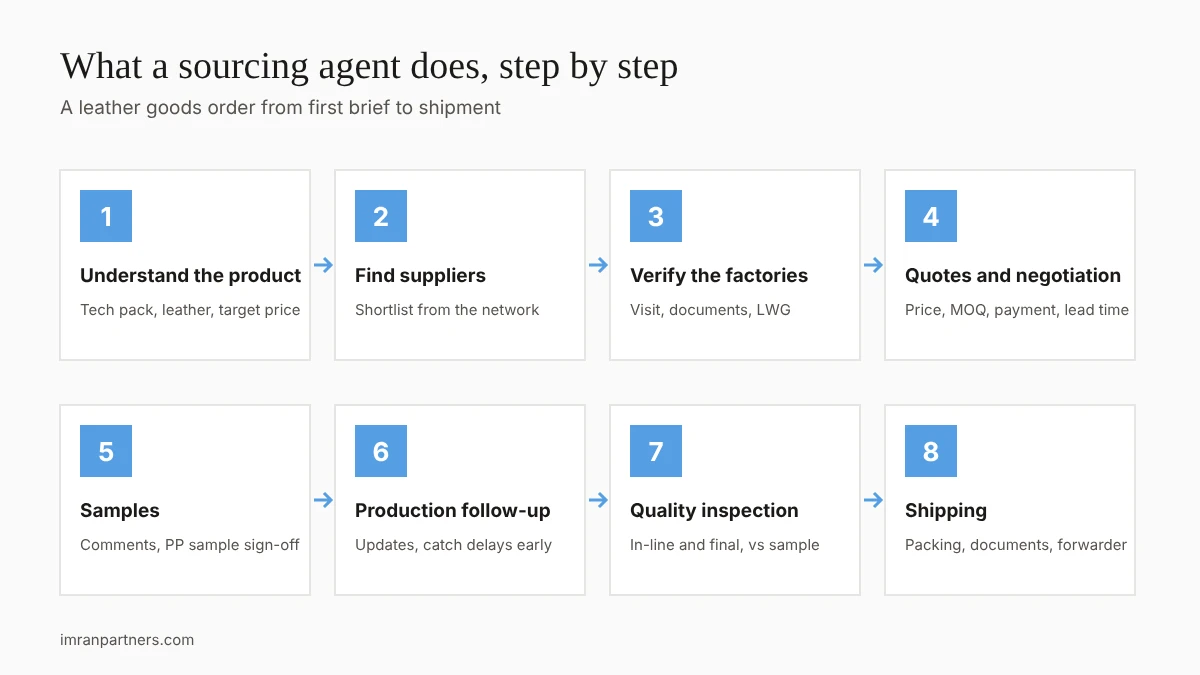
A sourcing agent's responsibilities follow the order from the first enquiry to the shipment. In leather goods the work usually looks like this:
- Understand the product. Tech pack, leather type and thickness, hardware, target price, quantity and delivery date.
- Find suppliers. Shortlist makers from the agent's supplier network that actually make this product at this quantity.
- Verify the suppliers. Visit, check the production floor, licences, export history and compliance documents such as LWG certification for the tannery.
- Request quotes and negotiate. Compare prices on the same specification, negotiate MOQ, payment terms and lead time.
- Manage samples. Send comments, check revisions and get a pre-production sample signed off.
- Follow production. Keep communication moving in the local language and time zone, and catch delays early.
- Inspect quality. In-line and final inspections against the approved sample before the balance payment.
- Help with shipping. Packing, documentation, freight forwarder and export customs paperwork.
Some agents also help with product development: suggesting a better leather for the price, a cheaper lining or a different construction. That is where real industry experience pays for itself.
Benefits of using a sourcing agent
The benefits go beyond finding a cheaper price:
- Someone on the ground: an agent can be at the production line in a day, which you cannot do from London or New York.
- Lower risks: verified suppliers, signed-off samples and inspections before the balance payment reduce the chance of a bad shipment or a scam.
- Better negotiation: an agent knows local prices, material costs and what MOQ a manufacturer will really accept.
- Language and culture: clear communication in Urdu or the local language avoids small misunderstandings that become expensive mistakes.
- Time saved: market research, supplier search and follow-up take weeks. An agent handles that part of your procurement while you sell.
- A more transparent supply chain: you know which tannery and which workshop made your goods, which matters for import rules and for your customers.
Types of sourcing agents
Independent sourcing agent
One person, often a former factory merchandiser or quality controller. Usually cheaper and very hands-on, but limited in how many orders and product types they can handle. Check what happens when they are sick or travelling.
Sourcing agency or sourcing company
A team with merchandisers, quality inspectors and someone who handles logistics. Better for brands with several products or regular orders. Ask who exactly will handle your account.
Full-service sourcing company
Covers everything from product design and development to warehousing and delivery to your door. Convenient, but you pay for every service, and some of them are trading companies under another name. Ask for the factory invoice.
Product-specific agent
Specialises in one industry, such as leather goods, textiles or sports goods. A general agent can find a supplier. A leather sourcing agent knows which tanneries supply it, what a fair price per square foot is and what goes wrong with each type of hide.
How much does a sourcing agent charge?
Sourcing agents charge in two main ways:
- Commission: a percentage of the order value. Simple, and it grows with your orders. The percentage usually falls as the order gets bigger.
- Fixed fee: a set price per task (supplier search, factory audit, inspection visit) or a monthly retainer. Easier to budget, and it does not reward the agent for pushing up the order value.
The fee depends on the product's complexity, the order size, how many suppliers need to be found, how many inspections you want and whether shipping is included. In Pakistan both models are common. We do not publish one "standard" rate, because a simple wallet reorder and a new jacket line with three workshops are very different jobs.
The question that matters more than the fee is this: is the agent also paid by the supplier? Some agents take a hidden commission from the supplier as well, which is a conflict of interest. They then push you towards the maker that pays them, not the one that fits your order. Ask in writing, and prefer an agent who lets you pay the factory directly against its own invoice.
Want to know what sourcing would cost for your product? Ask us about fees and we will tell you after a short look at your order.
When does a leather brand need a sourcing agent?
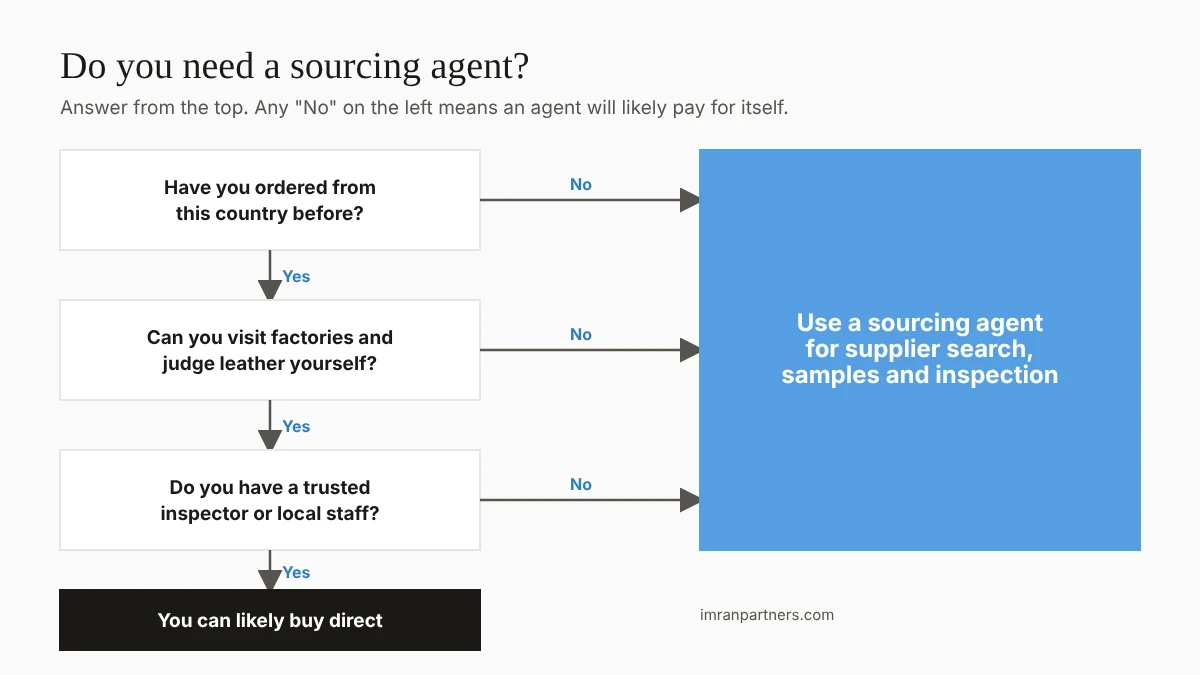
You probably need one if:
- It is your first order from Pakistan, or from any overseas factory.
- You cannot visit suppliers yourself, and you cannot judge leather quality from photos.
- You are buying several products (for example jackets and wallets) that come from different manufacturers.
- Your order is small and you need someone who can negotiate minimums with manufacturers that usually say no.
- You have had a bad shipment before: wrong colour, thin leather, poor stitching or missed deadlines.
You probably do not need one if:
- You already have a reliable supplier relationship and someone you trust does inspections.
- You have your own staff or office in Pakistan.
- You are buying a ready-stock product in small quantities where a mistake costs little.
One mistake we see often: a buyer approves a good sample, skips the bulk check to save time, and only finds out at the destination port that the leather is thinner or the colour does not match. The sample was fine. The bulk was not checked. That gap is exactly what an agent is there to close.
What a leather sourcing agent checks that a general agent misses
Leather is a natural material. Two hides from the same tannery can look and behave differently, so a leather-focused agent checks things a general sourcing agent may not know to look at:
- Hide type and grade: full grain, top grain or corrected grain, and whether the leather is the type you paid for. See our guide to goatskin leather for how one hide type compares with others.
- Thickness: measured in mm or ounces on bulk, not just on the sample. Our leather thickness converter helps you set the right spec.
- Tannery compliance: LWG rating and chrome-free or vegetable-tanned claims, backed by documents.
- Finish and colour: shade matching across dye lots, rub-off, smell and how the surface ages.
- Workmanship: stitch density, edge finishing, lining and hardware quality.
Our own first check at a new manufacturer is simple: is the sample they show made here, on this line? A showroom sample can be excellent while the production line uses a different leather grade or a weaker stitch. So we take a piece from the running line and compare it with the sample. That one check catches more problems than any certificate.
How to find and choose a sourcing agent
Where to find one
- Google and LinkedIn: search for the product and country, for example "leather sourcing agent Pakistan", and look at the people behind the company.
- Trade show visits: leather and fashion fairs where agents meet buyers in person.
- Referrals: other brands, freight forwarders and inspection companies know who is reliable.
- Directories and freelancer platforms: useful for finding names, but always do your own due diligence.
Questions to ask before you hire
- Which products and materials do you specialise in? Show me past work in leather.
- Will I know the factory name and address, and will the factory invoice me directly?
- How do you charge, and do you receive any payment from suppliers?
- Who does inspections, and what do your inspection reports look like?
- Can you give me references from buyers I can contact?
- What happens if the bulk does not match the sample?
Put the answers in a short contract: scope of work, fee, who pays whom, inspection standard, and who owns the supplier contacts. Our free checklist below lists every point, including import duties and who pays them.
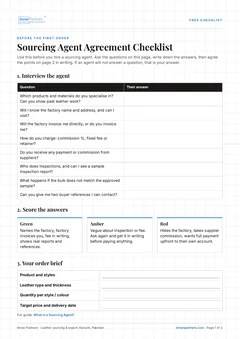
What to agree in writing with a sourcing agent before the first order.
⬇ Download free PDFIf you are still choosing manufacturers yourself, read how to find a reliable leather goods manufacturer in Pakistan first.
Doing it yourself instead? Start with these 15 questions for a new manufacturer, the same ones a good agent asks for you.
Red flags when choosing a sourcing agent
- They will not tell you the factory name or let you visit.
- Prices come only on their own invoice, with no factory invoice.
- They avoid the question about supplier commission.
- They promise any price, any MOQ and any delivery date without seeing your tech pack.
- No inspection report, no photos, no references.
- They ask for full payment upfront to their own account.
A common misunderstanding is that an agent makes goods more expensive. A good agent costs money, but it usually saves more than it costs: it prevents wrong orders, re-work and late shipments, which hurt a small brand far more than a few percent on the price. The second misunderstanding is that an agent and a trading company are the same thing. They are not: an agent should never need to hide the factory or the invoice.
Frequently asked questions
What is the difference between a sourcing agent and a supplier?
A supplier makes or sells the product. A sourcing agent works for the buyer to find and manage suppliers, check quality and negotiate. The agent does not make anything.
How much does a sourcing agent cost?
Most charge a commission as a percentage of order value, or a fixed fee per task or per month. The amount depends on the product, order size and how many services you need, so ask for a written quote.
Is a sourcing agent worth it for a small order?
Often yes, especially for a first order. Small buyers get the least attention from manufacturers, and an agent can negotiate minimums and check quality you cannot check from abroad.
What is the difference between a sourcing agent and a freight forwarder?
A sourcing agent finds suppliers and manages the order until it is ready. A freight forwarder moves the finished goods from the factory to your country. Many agents work with a forwarder for you.
What is a product sourcing agent for Amazon sellers?
It is a sourcing agent who also handles Amazon requirements such as labelling, barcodes and packaging rules, so the goods can go straight to an Amazon warehouse.
How do I become a sourcing agent?
Most agents start inside the industry, as merchandisers, quality controllers or factory staff, then build a supplier network and trust with buyers. Product knowledge and honest communication matter more than any course.
Can a sourcing agent guarantee quality?
No one can promise zero defects, but a good agent reduces the risk with clear specifications, sample approval and inspections before the balance payment, and reports problems before the goods ship.
Is a sourcing agent right for your leather brand?
A sourcing agent is your representative in the supplier's country: finding factories, negotiating, checking samples and inspecting the bulk. For a leather brand, pick one who knows hides and tanneries, shows you the factory and is open about how it is paid. For costs and order sizes, see our guide to leather jacket MOQ, samples and costs.
Looking for a leather sourcing agent in Pakistan? See how we work as a leather sourcing agent in Pakistan, or request a quote with your product and quantity.
Cover photo: This_is_Engineering on Pixabay

Muhammad Imran is the founder of Imran Partners, a leather sourcing partner based in Karachi, Pakistan. He works with leather goods manufacturers across Pakistan to help brands source jackets, bags, wallets, belts and gloves, from leather selection and sampling to quality checks before shipment.
Muhammad Imran on LinkedIn