Leather Jacket MOQ, Samples and Costs: Small Brand Guide
If you are a small brand ordering leather jackets for the first time, three questions decide whether the project works: what is the leather jacket MOQ (minimum order quantity), how does sampling work, and what will each jacket really cost once it reaches you? Factories answer these questions in their own shorthand, and quotes often leave out the parts that hurt later.
We sit on the buyer's side of the table in Karachi, between brands and the verified manufacturers we work with. This guide explains how MOQ is counted for leather, how to bring it down, what happens at each sample stage, how to turn a factory price into a landed cost, and how long the whole process takes.
Short on time? This two-minute video walks through the six steps of a first order, from picking one product to inspecting the goods before you pay the balance.
The video covers the steps for any product. The rest of this guide goes deeper for leather jackets: how MOQ is counted and how to lower it, what happens at each sample stage, what a jacket costs to make, and how long the whole process takes.
What MOQ means for a leather jacket order
MOQ is the smallest order a factory will accept for one product. For leather jackets it is rarely a single number. Before you compare quotes, ask the factory exactly how its minimum is counted:
- Per style: the minimum applies to each design. Two styles at the minimum means double the order.
- Per colour: many factories count each colour of the same style separately, because each colour is a separate dye lot of leather.
- Per leather type: lambskin, cowhide and goatskin are bought and cut differently, so a change of leather can count as a new style.
- Size run: the minimum is usually spread across sizes (for example S to XL). Ask whether you can choose the size split or whether the factory expects an even ratio.
Why leather factories set minimums
A minimum is not just a sales rule. Leather is bought by the hide, in lots from a tannery, and each colour is dyed in a batch. Cutting a jacket from natural hides also produces offcuts, and setting up patterns, cutting and the sewing line takes the same time whether the factory makes ten jackets or two hundred. A small order spreads those fixed costs over fewer pieces, which is why the price per jacket goes up as the quantity goes down.
Typical leather jacket MOQ for small brands
Minimums vary with the factory's size, the leather and the style. The table shows which way each type of order usually pushes the minimum; always confirm the exact number with the factory.
| Order type | Effect on MOQ | Why |
|---|---|---|
| Simple fashion jacket, stock leather | Lowest | Leather already in the factory's store, standard lining and hardware |
| Biker or bomber, custom colour | Higher | A custom dye lot, more panels and more hardware |
| Motorcycle jacket with armour pockets | Higher | Technical construction, armour and certification needs |
| Repeat order of an approved style | Often lower | Pattern and sample already approved, no new setup |
For comparison, published guides from other jacket makers quote factory minimums of roughly 100 to 500 units per style and colour for general jackets, with small-batch specialists starting around 50 pieces (Argus Apparel).
How to get a lower MOQ
Small brands can often get under the standard minimum. These are the levers that work most often:
- Use stock leather. If the factory already holds a leather in your colour, it does not need to buy a new lot. Ask what is in stock before you pick a custom shade.
- Mix colours within one style. Some factories accept one style split across two or three colours if the total meets the minimum.
- Keep the design simple for the first order. Fewer panels, standard hardware and a standard lining mean less setup.
- Accept a higher price per jacket. A factory may take a small run if the unit price covers its setup. Decide in advance how much extra you can carry.
- Promise a repeat, not a fantasy. A clear plan for a reorder is worth more to a factory than a vague "big orders later".
The first two work well together: one simple style in a stock leather, split across two colours, is an easy small order for a factory to say yes to.
Leather jacket sampling, step by step
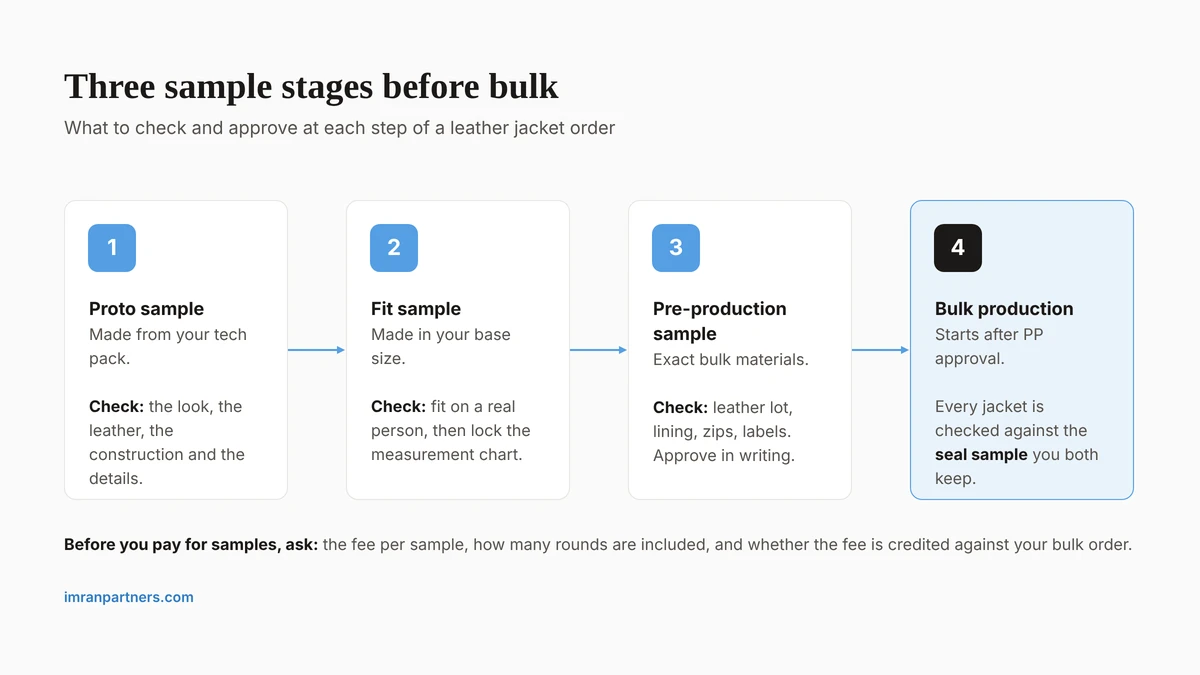
Never go to bulk production without approving a physical sample. Most jacket projects go through three stages:
1. Proto sample
The first version, made from your tech pack or reference photos. Check the overall look, the leather, the construction and the details. Expect changes; that is the point of this stage.
2. Fit sample
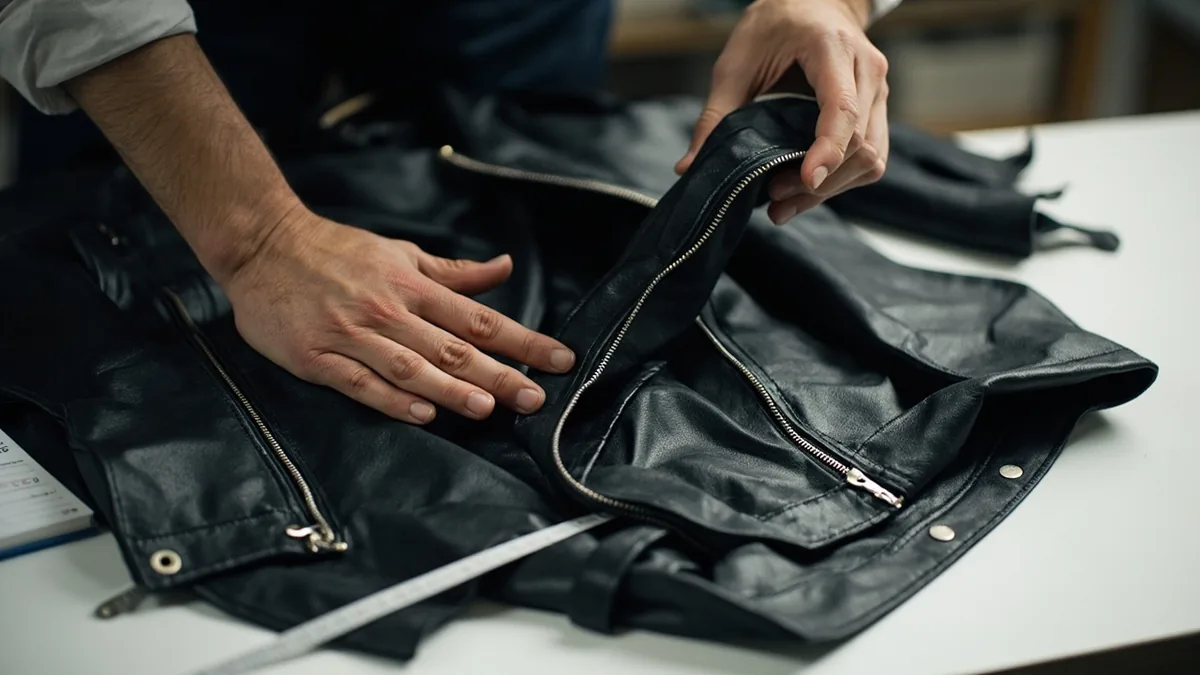
Made after your comments, in your base size. Try it on a real person, not just a hanger. Check the shoulders, sleeve length, chest and how the jacket moves. Fix the measurement chart now, because changing it after bulk cutting is very expensive.
3. Pre-production (PP) sample
The jacket exactly as the bulk order will be made: the final leather lot, lining, zips, labels and packing. Approve it in writing, keep one piece yourself and ask the factory to keep a matching "seal" sample. Every bulk jacket is checked against it.
Sample costs and timing
Sample fees cover pattern making, leather and skilled hours for a single piece, so one sample costs much more than one bulk jacket. Ask three things before you pay: the fee per sample, how many rounds are included, and whether the fee is credited against your bulk order.
Get the answers in writing, together with the time each sample round takes. A factory that is vague about sample fees is often vague about bulk terms too.
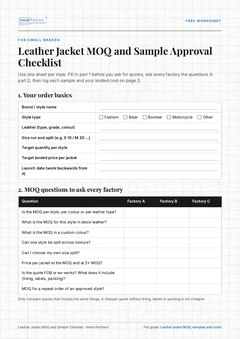
Free 2-page worksheet: MOQ questions to ask three factories side by side, a sample approval log, a landed cost worksheet and a pre-bulk checklist.
⬇ Download free PDFWant a jacket that ages with character? Ask for a semi-aniline or pull-up swatch and run the quick tests in our leather patina guide before you approve it.
When the sample arrives, check it point by point. Our leather jacket quality checklist covers stitching, hardware, lining and fit, and includes a sample photo guide you can send to your factory.
Before you pay for a sample, send the factory a short list of questions. Our guide to the questions to ask a manufacturer before your first order covers leather, tannery, samples, MOQ and payment.
What a leather jacket costs to make
The price per jacket is built from a few parts. Leather is usually the biggest one.
| Cost part | What drives it |
|---|---|
| Leather | Type (lambskin, goatskin, cowhide), grade (full grain or corrected), finish and how much area the pattern uses |
| Labour | Number of panels, quilting, stitching detail, size of the order |
| Lining and padding | Polyester, viscose or quilted lining; detachable liners |
| Hardware | Zip brand and weight, snaps, buckles, custom engraved pulls |
| Branding and packing | Woven labels, leather patches, embossing, hangtags, garment bags |
Leather choice alone can change the price a lot. Our guides to goatskin leather and how to tell if leather is real explain the main options and what to write in your tech pack.
Factory price vs landed cost
Most factory quotes are FOB (free on board): the price per jacket packed and delivered to the port or airport of export. Your real cost is the landed cost: FOB plus freight, insurance, import duty, customs clearance and local delivery. Here is a worked example with round numbers, to show the method rather than a real quote:
| Example: 60 jackets | Amount |
|---|---|
| FOB price, 60 × $80 | $4,800 |
| Air freight and insurance | $600 |
| Import duty (example rate 10% of goods value) | $480 |
| Customs clearance and local delivery | $200 |
| Total landed cost | $6,080 |
| Landed cost per jacket | about $101 |
In this example the jacket costs about a quarter more at your door than on the quote. Duty rates depend on your country and the product code, so check them before you set your retail price. You can run your own numbers with our free landed cost calculator.
The city matters too. See how Karachi, Sialkot and Lahore jacket manufacturers differ on leather, price and the route to the port.
Timeline: from tech pack to delivery
Lead times are where small brands most often get caught out. Plan backwards from your launch date.
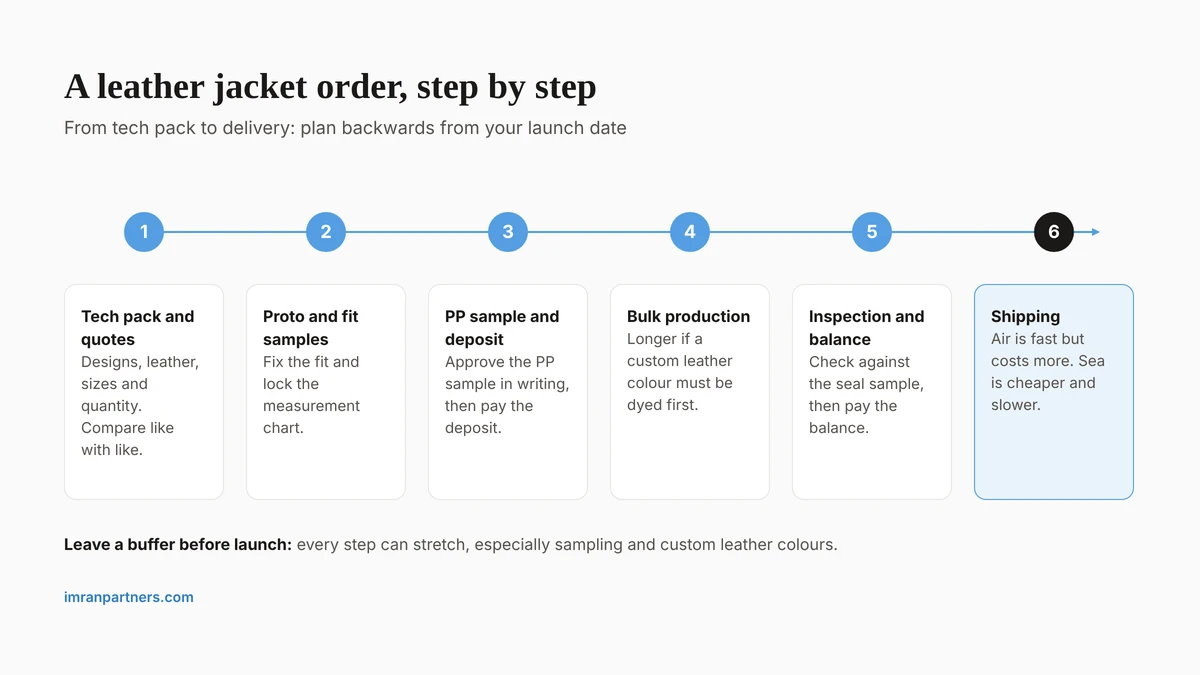
- Tech pack and quotes: share designs, leather, sizes and target quantity; compare quotes on the same basis.
- Proto and fit samples: usually one or two rounds; each round includes making the sample, shipping it and your feedback.
- PP sample and deposit: approve the PP sample in writing and pay the deposit agreed in your purchase order.
- Bulk production: starts after PP approval and takes longer if a custom leather lot must be dyed first.
- Inspection and balance payment: a pre-shipment check against the seal sample before you pay the balance.
- Shipping: air freight is fast but costs more; sea freight is cheaper and takes weeks longer.
Mistakes small brands make with a first leather jacket order
- Skipping the PP sample to save a week, then finding a different leather or zip in the bulk order.
- Comparing quotes that are not alike: one includes lining and labels, another does not; one is FOB, another ex-works.
- Too many styles at once: five styles at the minimum each is five times the risk. Start with one or two strong styles.
- No written spec: leather type, thickness, colour reference, zip brand and measurement chart should all be in the tech pack.
- No pre-shipment inspection: problems found after the goods arrive are much harder to fix.
If you are still choosing a factory, read our guide on how to find a leather goods manufacturer in Pakistan, or see how we work with leather jacket manufacturers in Pakistan.
Do not forget the care label: most customer complaints come from home washing. See how to clean a leather jacket and the care-label template for brands in that guide.
If you cannot visit factories or check bulk quality yourself, read what a sourcing agent does and when a leather brand needs one.
Frequently asked questions
What is a typical leather jacket MOQ?
It depends on the factory, the leather and the style. Small-batch specialists often start around 50 pieces per style, while larger factories may ask for 100 to 500 per style and colour.
Can I order leather jackets without a minimum?
Some workshops make single pieces, but the price per jacket is much higher. For a brand, a small first run at a slightly higher unit price is usually the better balance.
How many sample rounds should I expect?
Usually two or three: a proto sample, a fit sample and a pre-production sample. Simple styles from an existing pattern can need fewer.
Is the sample fee refunded?
Sometimes. Some factories credit the sample fee against the bulk order once you place it. Ask before you pay and get the answer in writing.
Does MOQ count per colour?
Often yes, because each colour is a separate leather dye lot. Some factories accept mixed colours within one style if the total meets the minimum.
What is the difference between FOB and landed cost?
FOB is the factory price up to the export port. Landed cost adds freight, insurance, import duty, clearance and delivery, so it is the number to use for your retail pricing.
How long does a leather jacket order take?
From tech pack to delivery, plan for several months: a few weeks of sampling, several weeks of bulk production, then shipping. Custom leather colours add time.
Start your leather jacket order with confidence
The leather jacket MOQ, the sampling plan and the landed cost decide whether a first order makes money. Ask how the minimum is counted, approve a PP sample in writing and price your jackets on landed cost, not on the factory quote.
Planning a first run or a reorder? Request a quote with your style, leather and quantity, and we will match you with verified manufacturers in Pakistan that fit your order size.
Muhammad Imran is the founder of Imran Partners, a leather sourcing partner based in Karachi, Pakistan. He works with leather goods manufacturers across Pakistan to help brands source jackets, bags, wallets, belts and gloves, from leather selection and sampling to quality checks before shipment.
Muhammad Imran on LinkedIn